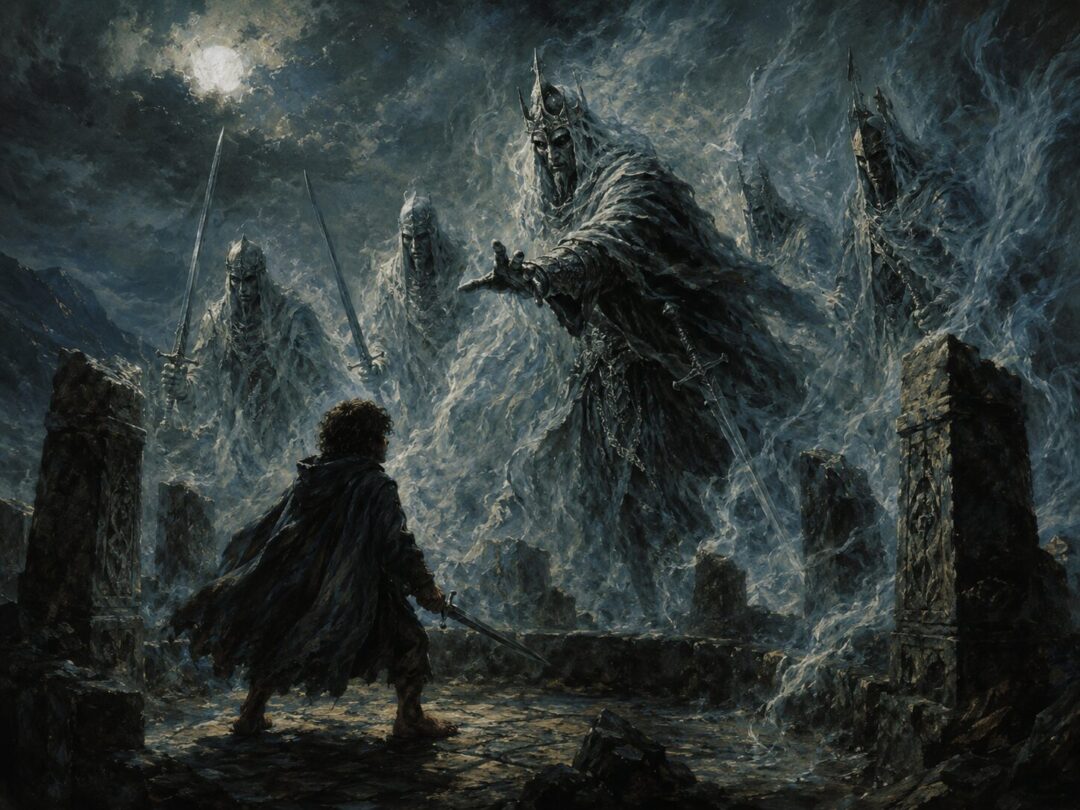
The most terrifying thing Frodo sees on Weathertop is not simply the Ringwraiths.
Before that night, the Black Riders are frightening because they are almost unknown. They are cloaked pursuers on the roads of the Shire, whispering figures at the inn, shadows sniffing after him through the dark. Their horror depends partly on concealment. They are more felt than understood.
But when Frodo puts on the Ring on Amon Sûl, the veil changes.
He does not merely become invisible. He sees the Nazgûl differently. The cloaks that hid them from ordinary sight no longer matter in the same way. He sees their pale, terrible forms, their ancient presence, and the crowned figure of their captain. For a moment, Frodo is not just a frightened hobbit looking at monsters. He is looking into the world in which those monsters truly exist.
That changes the meaning of his fear.
Because from that point onward, Frodo’s struggle is no longer only about being chased by servants of Sauron. It is about being pulled, slowly and painfully, toward the same unseen order of existence that has consumed them.
The Ring Did Not Simply Hide Frodo
One of the easiest misunderstandings about the One Ring is to treat invisibility as its main effect. For Bilbo, and at first for Frodo, that is the obvious practical power. Put it on, disappear from ordinary eyes.
But the Ring does not make its wearer vanish from reality. It shifts the wearer’s relationship to reality.
In The Lord of the Rings, the Ring’s invisibility is connected with the Unseen: the spiritual or hidden side of the world where beings like the Ringwraiths are revealed more clearly. Mortals who wear the Ring are not simply hidden; they are drawn partly out of the ordinary visible world. That is why the Ring is so dangerous in the presence of the Nazgûl. It does not make Frodo safe from them. It brings him closer to the plane where they are most terrible.
On Weathertop, Frodo’s use of the Ring is therefore tragically ironic. He reaches for it because terror and pressure overwhelm him. Yet the very act that seems like escape makes him more visible to his enemies in the deeper sense.
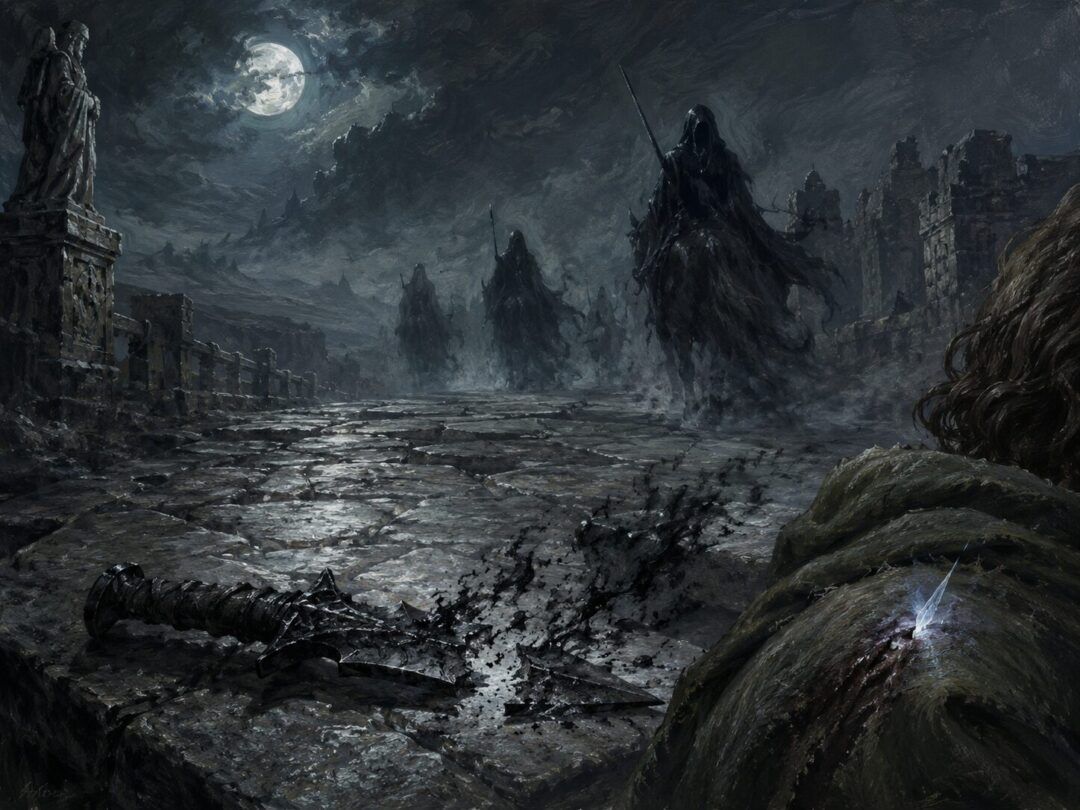
The text does not present this as a simple “mistake” of strategy. Frodo is under extreme supernatural fear. The Nazgûl are not ordinary pursuers; their presence bends courage, weakens the will, and fills the mind with dread. But the result is still devastating. Frodo sees what he was never meant to see, and the Witch-king is able to strike him with the Morgul-knife.
What Frodo Sees on Weathertop
Before putting on the Ring, Frodo sees the Riders as shadowy shapes. After putting it on, their appearance changes. They become clearer, more dreadful, and more personal.
He sees them as tall figures, pale and grave-like, with ancient weapons and faces no longer hidden by their black garments. Their leader appears crowned. This is not just a visual scare. It is a revelation.
The Nazgûl are not ghosts in the vague sense. They were once mortal kings, sorcerers, and warriors, men who accepted Rings of Power and were slowly consumed by them. Their bodies faded, their wills were enslaved, and their identities became bound to Sauron. In ordinary sight, they are nearly invisible without their robes. In the Unseen, however, their terrible reality is clearer.
So when Frodo sees them on Weathertop, he is seeing the result of a long corruption: what happens when a mortal creature is drawn too far into domination by a Ring of Power.
That matters because Frodo is carrying the Ruling Ring itself.
The vision is not just “these are the enemies.” It is also, in a dark mirror, “this is one possible end of the road.”
The Morgul Wound Was an Attempt to Change What Frodo Was
The wound Frodo receives is not a normal injury. The knife breaks, and a splinter remains in him, working inward. At Rivendell, Gandalf explains that if the attempt had fully succeeded, Frodo would have become like the Ringwraiths, though weaker and under their command.
That is one of the most important details in the entire early story.
The Nazgûl were not merely trying to kill him. A dead Ring-bearer would be one thing. A wraith-like Frodo under Sauron’s command would be something far worse.
The attack was an act of spiritual capture.
The blade was aimed not only at his body but at his nature. It was trying to draw him out of the living world and into the condition of the enslaved wraiths. In that sense, Weathertop is not just Frodo’s first great wound. It is the first moment where the quest nearly ends by transformation rather than death.
This is why the wound continues to matter after it is healed. Elrond removes the splinter, but Frodo is not simply restored to what he was before. He survives, but survival does not erase the contact. He has been touched by the same darkness that made the Nazgûl what they are.
Fear Becomes Knowledge
Before Weathertop, Frodo fears the Black Riders because they are hunting him.
After Weathertop, he fears them with knowledge.
This is a different kind of fear. A person who has never seen the abyss may dread falling into it. A person who has looked over the edge carries that sight within them. Frodo now understands, in some measure, that Sauron’s power is not limited to armies, spies, or pursuit. It can alter the very condition of a living being.
That knowledge deepens the moral weight of the quest.
Frodo is not carrying an object that merely attracts enemies. He is carrying something bound to a hidden order of domination. The Ring belongs to a realm of power where wills can be exposed, bent, and enslaved. The Nazgûl are proof of that truth. They are not Sauron’s soldiers only; they are Sauron’s evidence.
Their existence says: this is what power without mercy can do to the soul.
And Frodo has now seen them more truly than almost anyone in the ordinary world could bear.
Rivendell Does Not Undo the Change
Rivendell is a place of healing, but it is not a reset.
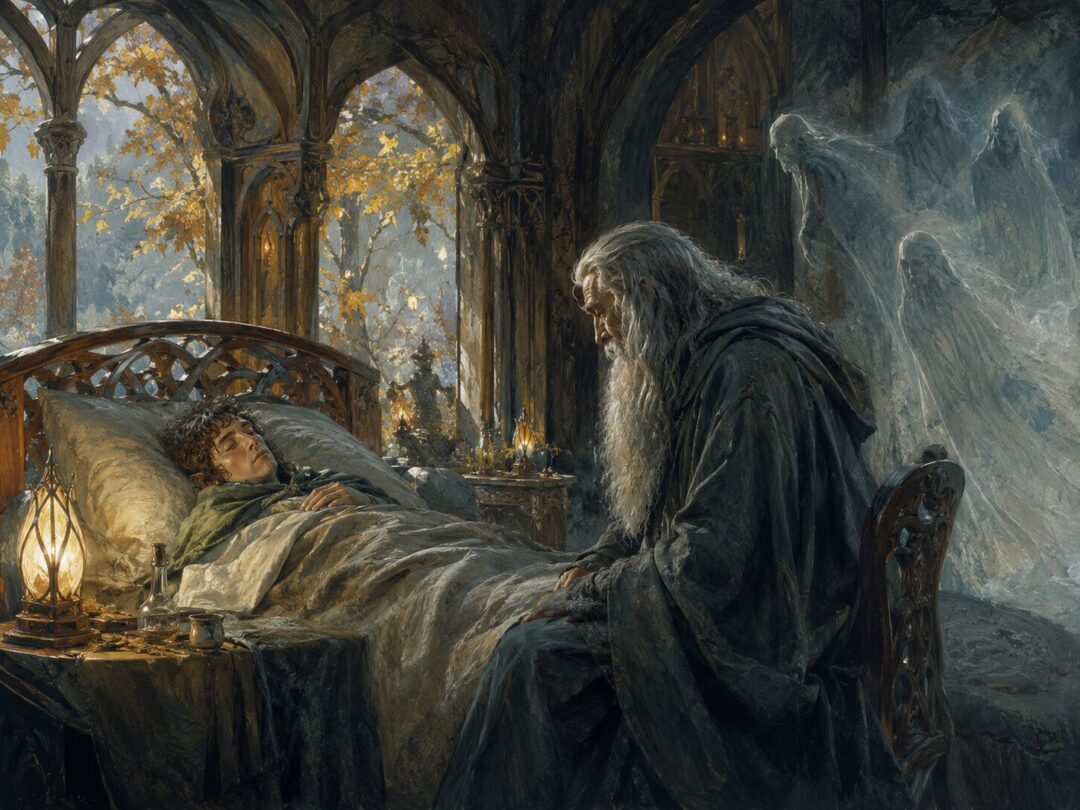
Frodo wakes in safety. The fragment has been removed. He is among friends. The immediate danger has passed. Yet Gandalf’s words make clear that something lasting has happened. Frodo was close to becoming a wraith. He is recovering from more than blood loss or poison.
There is also a strange hint of transformation in Gandalf’s later description of Frodo. He suggests that Frodo may become like a glass filled with clear light for eyes that can see. That is not a simple statement of physical health. It implies that Frodo’s suffering, burden, and resistance are changing him inwardly.
This must be phrased carefully. Frodo does not become an Elf. He does not gain a permanent superpower. He does not become a master of the Unseen. But the texts do imply that his experience leaves him spiritually altered, more transparent to certain kinds of perception, and more deeply marked by the conflict between light and shadow.
His fear has become part of his wisdom.
Glorfindel and the Other Side of Sight
The flight to the Ford of Bruinen adds another important piece.
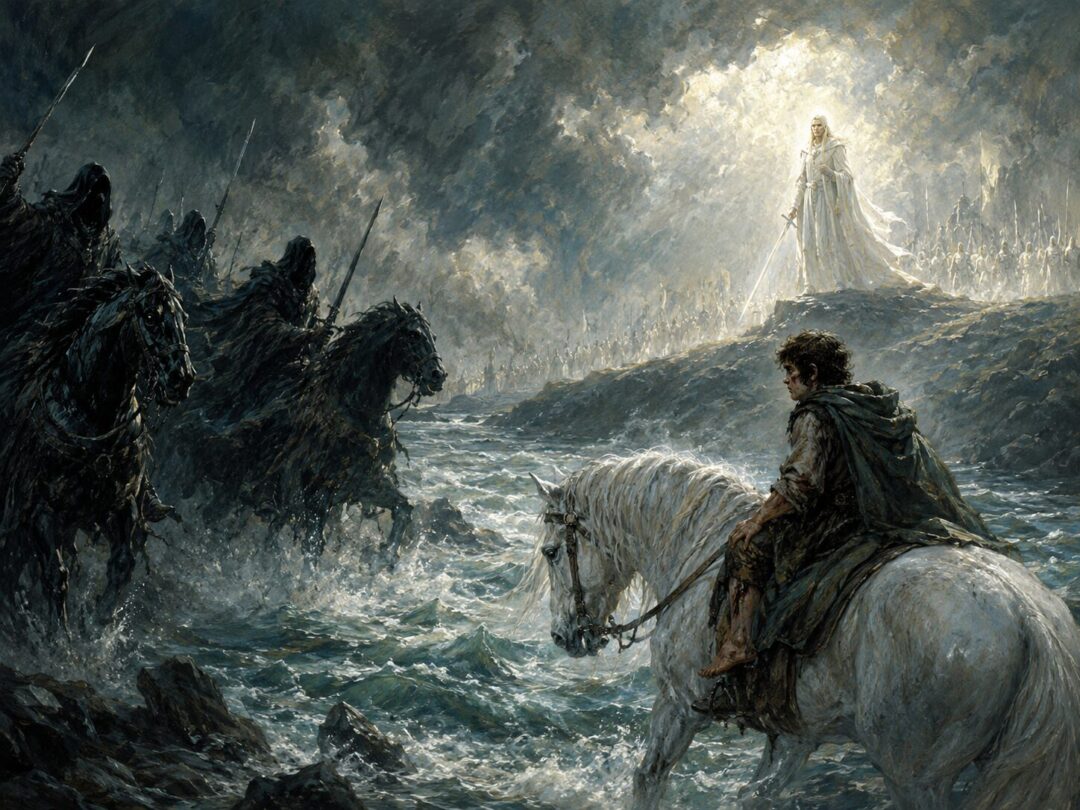
As Frodo weakens under the wound, he begins to perceive Glorfindel differently. Glorfindel is one of the High Elves, and Gandalf later explains that Frodo saw him for a moment as he is “on the other side.” The implication is that some of the Eldar, especially those who had dwelt in the Blessed Realm, have a presence in both the Seen and the Unseen.
This matters because it prevents the Unseen from being reduced to “the evil world.”
The wraith-world is the horror Frodo encounters through the Ring and the Morgul wound, but the hidden side of reality is not owned by Sauron. The Ringwraiths are dreadful there, but so is Glorfindel radiant. Darkness is powerful in that realm, but it is not the only power.
That is a crucial distinction. Frodo’s new awareness does not only teach him that evil is deeper than he thought. It also hints that goodness, holiness, and ancient strength are deeper than ordinary sight can reveal.
The same hidden reality that exposes the Nazgûl’s terror also reveals Glorfindel’s glory.
The Wound Becomes a Memory That Returns
Frodo’s injury never becomes irrelevant. Even after the quest moves far beyond Weathertop, the wound remains part of him.
Later, he suffers on the anniversary of the attack. He is also wounded again by Shelob and tormented by the burden of the Ring. These wounds are distinct, and they should not be collapsed into one simple condition. But together they show that Frodo’s suffering is cumulative. Middle-earth can be saved, but the one who carries the burden may not return untouched.
This is one of the great moral costs of the story.
The quest is not a tale where courage means escaping damage. Frodo’s courage often means continuing after damage has already entered him. The Morgul wound is the first sign that his sacrifice will not be clean or easily healed.
He has seen too much. He has carried too much. He has been pulled too near to the shadow that consumed the Nine.
Why This Changes His Mercy
Frodo’s mercy toward Gollum has many roots. Bilbo’s earlier pity matters. Gandalf’s counsel matters. Frodo’s own goodness matters. But Frodo’s experience of the Ring and the Wraith-world gives that mercy a darker depth.
He increasingly understands that corruption is not always sudden. It can be slow, intimate, and humiliating. It can shrink a person’s freedom while leaving enough self-awareness for misery. Gollum is not a Ringwraith, and his condition is different from theirs. But he is another living witness to what the Ring does over time.
Frodo’s pity is not naive because he has seen evil clearly.
He has seen the Nazgûl. He has felt the wound. He knows that the Ring is not just a treasure that makes people greedy. It is a power that invades desire, identity, and will. That knowledge makes his compassion more costly, not less. He does not spare Gollum because he fails to understand danger. He spares him while understanding danger more than almost anyone else could.
That is part of what separates Frodo from the logic of the Enemy.
Sauron sees persons as instruments. Frodo, even under terrible pressure, continues trying to see persons as persons.
The Ring-bearer Becomes Harder to See Simply
By the time Frodo reaches Mordor, he is no longer the same hobbit who left Bag End. He is still Frodo, still capable of tenderness and endurance, but he is also increasingly burdened by an invisible conflict.
Sam often sees the outer signs: exhaustion, pain, hunger, the growing weight of the Ring. But the deeper battle is harder to describe. Frodo is being pressed by the Ring’s claim, by Sauron’s searching will, and by the memory of wounds that never fully leave him.
His vision of the Wraith-world at Weathertop foreshadows this. The quest will become less and less about visible roads and more and more about invisible pressure. The true battlefield is not only the plains before Minas Tirith or the slopes of Orodruin. It is also the interior place where Frodo’s will is strained almost beyond endurance.
Seeing the Ringwraiths as they truly are is the first great glimpse of that battlefield.
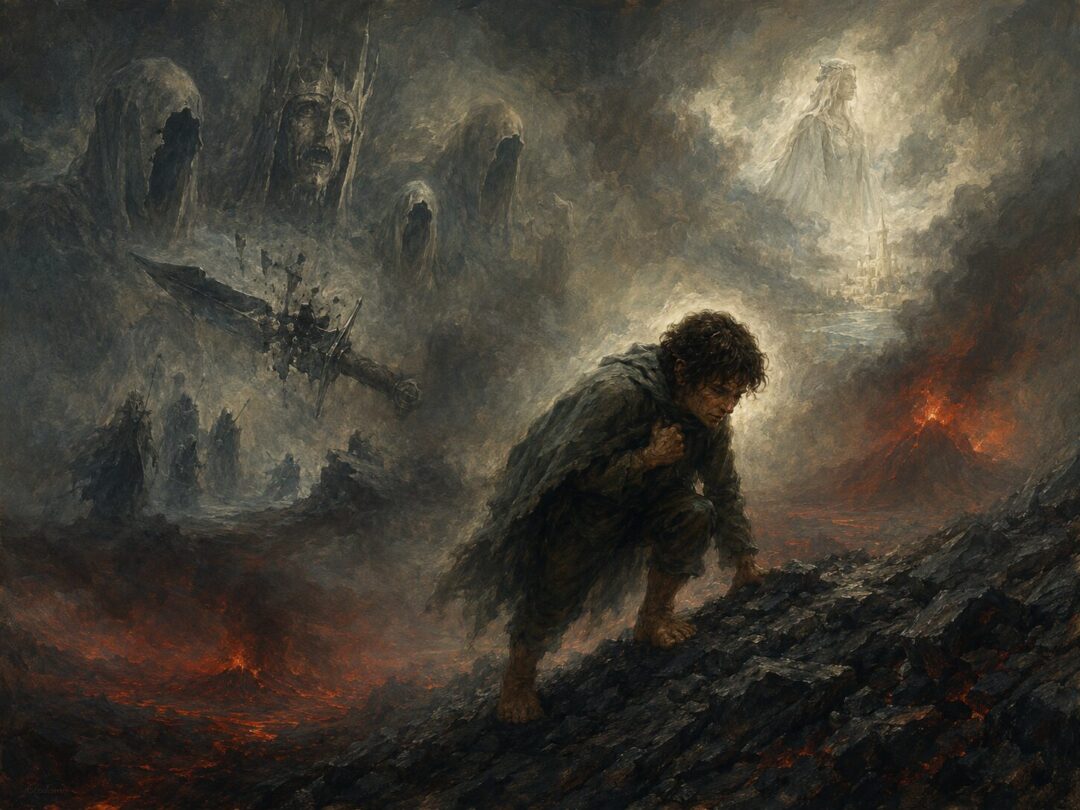
The Horror Was Not That Frodo Saw Monsters
The horror was that Frodo saw a hidden truth.
The Nazgûl are terrifying because they reveal what domination looks like after it has finished its work. The Morgul wound is terrifying because it shows that Sauron’s servants do not only destroy bodies; they seek to claim beings. The Ring is terrifying because it opens doors that mortals were not meant to open safely.
But the same episode also reveals something else. Frodo resists. Wounded, terrified, and overmatched, he still calls on a name of holiness and strikes at the feet of the Witch-king. He is not victorious in any ordinary martial sense, but he is not simply passive.
That small resistance matters.
Frodo’s sight of the Wraith-world changes more than his fear because it gives his fear shape. It shows him the nature of the enemy, the danger of the Ring, and the possible fate from which he has narrowly escaped. After Weathertop, he is not merely fleeing darkness. He understands that darkness wants to remake him.
And yet he continues.
That is why Frodo’s journey is so much more than the story of a small hero carrying a dangerous object. It is the story of someone who has looked into the realm of enslavement, felt its blade inside him, and still chooses mercy, endurance, and pity for as long as he can.
The Wraith-world does not only show Frodo what he fears.
It shows him what he must refuse to become.
Sources & Notes
- J.R.R. Tolkien, The Lord of the Rings, Book I, ch. 11 “A Knife in the Dark”: Frodo puts on the Ring at Weathertop, sees the Ringwraiths unveiled as pale figures, and is struck by the Witch-king’s Morgul-knife.
- J.R.R. Tolkien, The Lord of the Rings, Book I, ch. 12 “Flight to the Ford”: Frodo’s worsening wound, his fading into the wraith-world, and his changed perception of the Riders and Glorfindel on the road to Rivendell.
- J.R.R. Tolkien, The Lord of the Rings, Book II, ch. 1 “Many Meetings”: Gandalf explains the knife-splinter’s purpose—to make Frodo a wraith under the Enemy’s command—and reflects on Frodo becoming “like a glass filled with a clear light.”
- J.R.R. Tolkien, The Lord of the Rings, Book I, ch. 2 “The Shadow of the Past”: Gandalf identifies the Black Riders as the Ringwraiths and frames the Ring as a power that can possess and dominate its bearer, not merely make someone invisible.
- J.R.R. Tolkien, The Silmarillion, “Of the Rings of Power and the Third Age”: the Nine Rings turn mortal kings, sorcerers, and warriors into the Nazgûl, showing the long corruption behind what Frodo glimpses in the Unseen.
- J.R.R. Tolkien, The Letters of J.R.R. Tolkien, Letter 131: Tolkien’s storycraft account of Sauron’s Ring as an instrument for enslaving wills, useful context for the article’s domination-and-transformation reading.