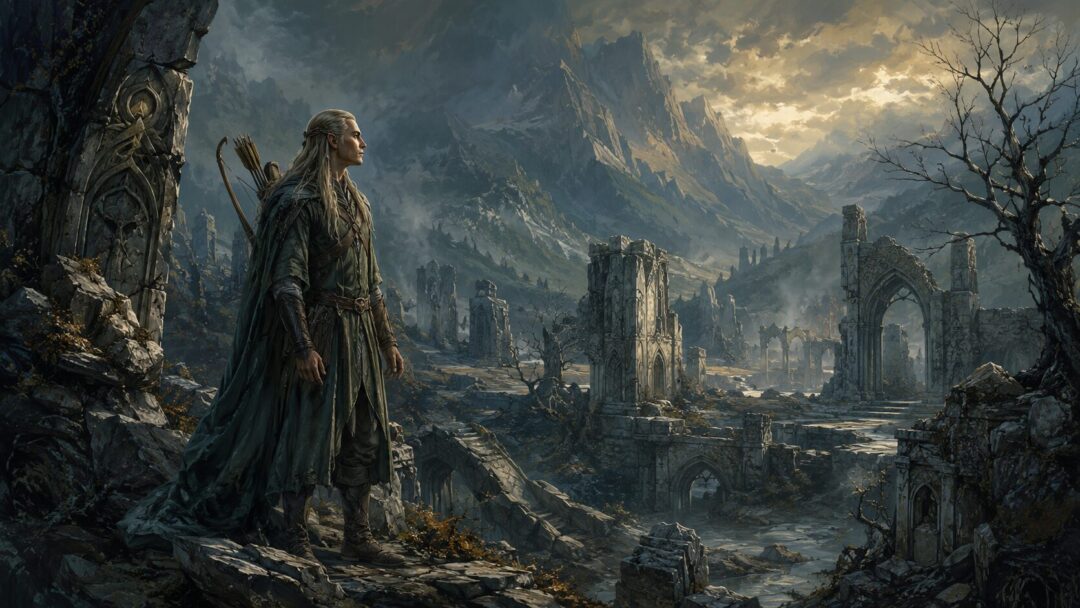
Legolas hears something in Hollin that almost no one else in the Fellowship can hear.
The Company is crossing the old land of Eregion, once called Hollin, where the Elven-smiths had lived before Sauron’s war ruined them. To most of the travellers, the place is simply quiet. Aragorn remembers it. Gandalf knows its history. Gimli feels the weight of Dwarven friendship and loss nearby, because Moria lies ahead.
But Legolas hears the stones.
Not merely the wind over them. Not merely some poetic sadness projected onto old ruins. The text gives him a distinctly Elven sensitivity to the place itself: the air speaks of the Elves who once lived there, and the stones seem to lament their makers’ departure. Legolas hears grief embedded in the land.
And yet this same Legolas does not see the true end coming.
He can sense old sorrow in stone, walk lightly over snow, see far across plains, hear what others miss, and read the moods of places better than almost anyone in the Fellowship. But the decisive movement of the age still happens beyond him: two small Hobbits crawling through Mordor, a broken creature following them, and the Ring ending not through Elven sight, warrior strength, or ancient wisdom, but through pity, endurance, and providence.
That is the strange beauty of Legolas in The Lord of the Rings. He is not dull. He is not naïve. He is, in many ways, one of the most perceptive members of the Company. But Tolkien’s world repeatedly shows that perception is not the same as understanding, and beauty is not the same as salvation.
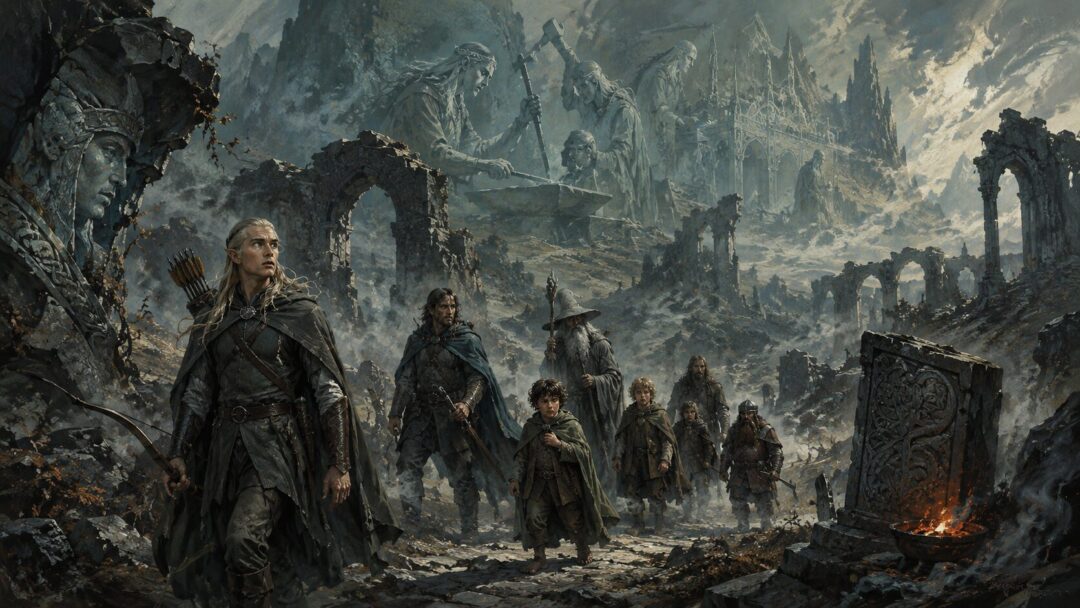
The Stones of Hollin Remember What the Living Have Lost
Hollin is not just scenery. It is one of the great haunted thresholds in The Fellowship of the Ring.
Before the Fellowship reaches Moria, they pass through the remnants of Eregion, the land once associated with the Gwaith-i-Mírdain, the Elven-smiths who made the Rings of Power with knowledge connected to Sauron’s deception. The place is empty by the time the Fellowship arrives, but not spiritually blank. Legolas responds to it as though the land itself has retained an echo of its former inhabitants.
This matters because Legolas is not hearing random magic. He is hearing memory.
The stones remember that they were shaped, built, and loved. The land remembers the Elves who walked there. The grief is not merely that a city fell, but that craft, beauty, and presence have gone out of the world.
That is one of the deepest patterns in Middle-earth: the world is full of traces. Ruins are not dead. Names are not empty. Roads, rivers, mountains, gates, swords, and even songs carry the pressure of what came before.
Legolas is especially alive to that pressure. As an Elf, he belongs to a people whose experience of time is radically different from that of Men, Hobbits, or even Dwarves. Elves do not simply remember in the ordinary sense. They are bound to the world while it lasts, and their grief is often grief over the slow fading of things they still love.
So when Legolas hears the stones of Hollin, the moment reveals something profound: he lives in a world where the past is not safely past.
Elven Perception Is Deep, But It Is Not Omniscience
It is easy to overstate what Legolas can do.
He has extraordinary sight. He can read distant movement. He can travel lightly. He is alert to sounds and changes in the natural world. He is also emotionally responsive to places in a way the mortals around him often are not.
But the texts never make him all-knowing.
Legolas can hear the grief of stones, but he cannot read the hidden future. He can sense the memory of Eregion, but he does not understand every consequence of Eregion’s tragedy. He can stand in the old lands of the Ring-makers and feel their absence, but the full burden of the One Ring is still being carried quietly by Frodo.
This distinction is crucial.
In Middle-earth, great perception often comes with limits. Galadriel can perceive much, but she is still tested. Elrond has deep wisdom, but he cannot make the Quest safe. Gandalf knows more than almost anyone in the story, but even he must move through uncertainty. Aragorn can read signs on the land, but he cannot control what those signs will lead to.
Legolas belongs to that same pattern. His senses are astonishing, but they do not free him from the central uncertainty of the Quest.
The fate of the age is not visible in the way an army is visible. It cannot be solved by looking farther across the plain. It is hidden in weakness, mercy, and the long consequences of choices that seemed small when they were made.
Eregion Is the Perfect Place for Legolas to Be Both Right and Limited
Hollin is the ideal setting for this contradiction because Eregion itself was a place of brilliance and blindness.
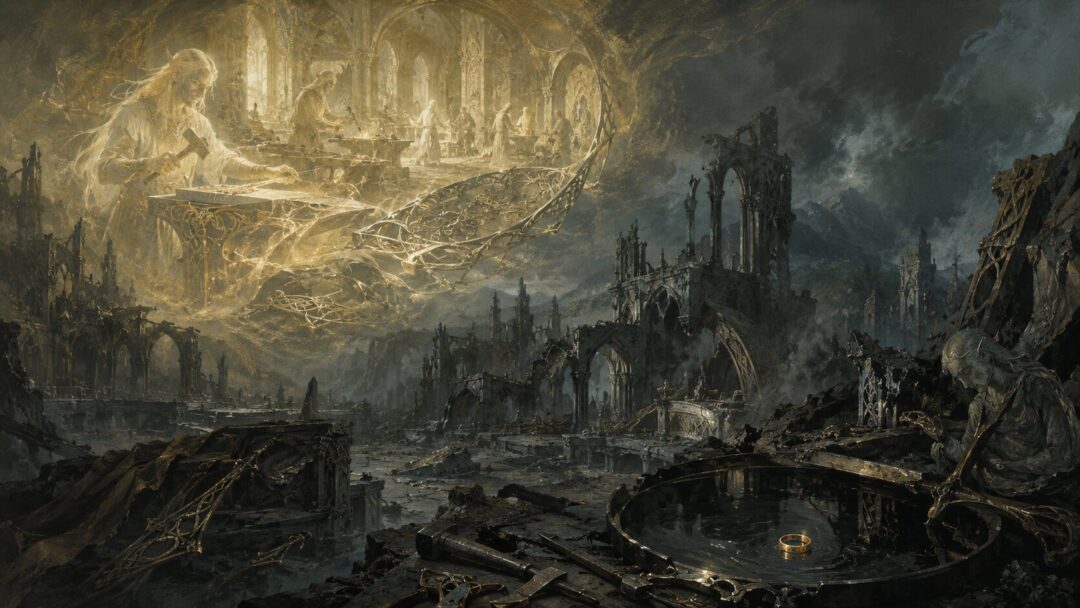
The Elven-smiths made works of tremendous power there. The Rings of Power were tied to a desire not merely for domination, at least on the Elven side, but for preservation: the wish to resist decay, to keep beauty unstained, to hold back the weariness of the world. Yet Sauron exploited that desire.
That does not mean the Elves of Eregion were evil. The lore is more tragic than that. Their longing to preserve beauty became vulnerable to corruption because Sauron knew how to twist noble desires toward his own rule.
So when Legolas hears the stones grieving, he is hearing the aftermath of a disaster born partly from beauty itself.
That is why the moment is so haunting. The stones do not cry, “They were wicked.” They lament: they built us, shaped us, raised us, and now they are gone.
Legolas can feel the wound. But the deeper wound — the one that still threatens the world — is not in the stones anymore. It is in the Ring Frodo carries.
That is the hidden irony. Legolas is walking through the memory of the Ring-makers while the true danger made possible by that history is moving beside him in the hand of a Hobbit.
The World Ending Does Not Look Like an Ending at First
When we say Legolas “misses the world ending,” it should be understood carefully.
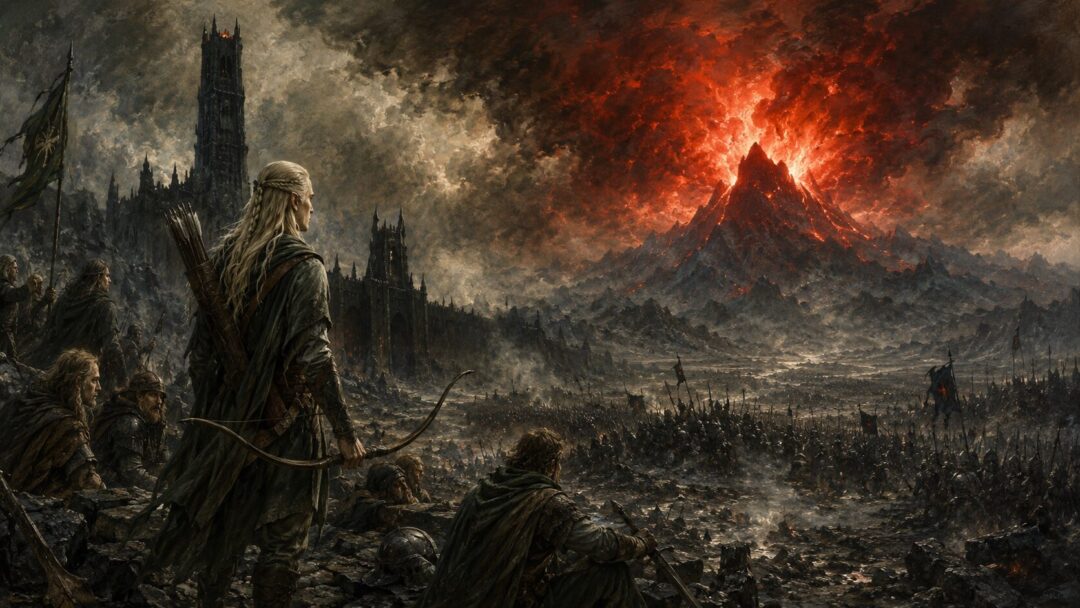
He does not miss Sauron’s defeat as an event. At the Black Gate, he is among those who witness the sudden collapse of Sauron’s power after the Ring is destroyed. He sees the battle turn. He sees the shadow break. He lives through the end of the War of the Ring.
But he is not present at the hidden center of it.
The world-changing act happens far away in the Sammath Naur, the Chambers of Fire inside Mount Doom. It happens with Frodo at the edge of failure, Sam helpless to complete the act for him, and Gollum becoming the terrible instrument by which the Ring is finally destroyed.
No great Elf stands there. No prince of the Woodland Realm. No lord of Rivendell. No captain of Gondor. No one whose eyes can pierce miles of air.
The ending of the age is not given to the keenest sight.
This is not accidental. The Lord of the Rings repeatedly shifts the burden of history away from the visibly mighty. The great powers distract Sauron. Aragorn marches to the Black Gate not because he can defeat Mordor by force, but because he can draw the Eye away. The armies matter, but they are not the final weapon.
The true movement is small, hidden, and almost unbearable.
Legolas can hear stones lamenting the loss of an ancient people. But the sound that ends Sauron’s dominion is not a sound he can hear from where he stands. It is the fall of the Ring into the Fire, brought about in a place where perception, strength, and nobility have all reached their limits.
Legolas Understands Beauty Before He Understands Departure
Another layer of the tragedy is that Legolas’s own ending in Middle-earth begins before he fully recognizes it.
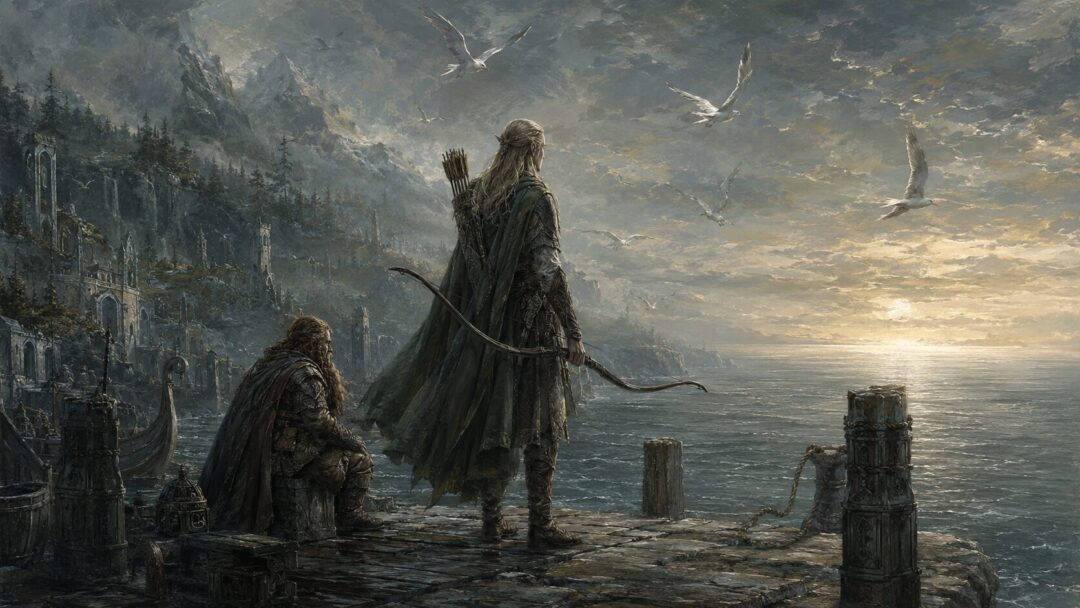
Galadriel’s message to him warns of the Sea. Later, when he hears the gulls, the sea-longing awakens in him. He says that no peace will remain for him under beech or elm. This does not mean he immediately abandons Middle-earth. He remains for a time, and tradition in the appendices says he later brings Gimli with him over Sea, a remarkable sign of their friendship.
But from the moment the sea-longing is stirred, Legolas is no longer simply a woodland prince moving through the War. He becomes part of the larger fading of the Elves.
This is where “the world ending” becomes more than Sauron’s fall.
For Men and Hobbits, the destruction of the Ring is deliverance. For the Elves, it is also loss. The Three Rings lose their power when the One is destroyed. The preserved realms that had resisted time can no longer remain as they were. The victory that saves Middle-earth also confirms that the Elven age is passing.
Legolas helps win a world he cannot keep.
That is one of the quietest sorrows in the story. He hears the stones of Hollin grieving for departed Elves, but by the end, he himself is moving toward departure. The lament he heard in Eregion was not only about the past. It was a foreshadowing of his own people’s fate.
Why His Friendship With Gimli Matters So Much
Legolas’s bond with Gimli is often remembered because it heals, in miniature, the long estrangement between Elves and Dwarves. But it also deepens this theme of perception and missed meaning.
At first, Legolas can hear the stones of Hollin, but Gimli is the one who will soon experience Moria as a living wound of Dwarven loss. In Lothlórien, both are changed: Gimli by Galadriel, Legolas by witnessing Gimli’s unexpected reverence. Their friendship becomes one of the clearest signs that the old divisions of Middle-earth are not absolute.
This is important because Legolas’s greatest growth may not be sensory at all.
He already has keen sight. He already hears what others miss. What he gains through the Quest is not sharper hearing, but a wider heart.
He learns to love across an ancient boundary. He learns that beauty is not only Elvish, grief is not only Elvish, and loyalty may come in forms his people once mistrusted. His friendship with Gimli does not solve the fading of the Elves, but it does answer it with something unexpectedly durable.
The world is ending, but not everything is wasted.
The Hidden Lesson of Legolas’s Hearing
Legolas hearing the stones is one of those small moments that reveals the moral architecture of Middle-earth.
The world is alive with memory. The past speaks. Beauty leaves traces. Grief can cling to stone. Those with ears trained by long life and deep love may hear what others cannot.
But even the deepest sensitivity cannot master history.
Legolas can hear what is gone, but he cannot prevent more from passing away. He can sense old sorrow, but he cannot stand at the center of the final act. He can see far, but the salvation of Middle-earth moves through hidden paths, small hands, and mercy extended long before anyone understands its full importance.
That is why the contrast is so powerful.
The Elf who hears stones does not fail because he lacks perception. He “misses” the world ending because the world does not end in the place where beauty, nobility, and ancient memory are most visible. It ends quietly, terribly, and mercifully, in a chamber of fire where power defeats itself.
And when it is over, Legolas is left in the new world like the stones of Hollin were left in the old one: full of memory, full of song, and already listening for a departure that cannot be stopped.
Sources & Notes
- J.R.R. Tolkien, The Lord of the Rings, Book II, Chapter 3, “The Ring Goes South” — in Hollin/Eregion, Legolas says he alone can hear the stones lamenting the Elves who made them and departed.
- J.R.R. Tolkien, The Lord of the Rings, Book II, Chapter 3, “The Ring Goes South” — Legolas’s light travel over snow and keen Elven perception show his unusual senses without making him omniscient.
- J.R.R. Tolkien, The Silmarillion, “Of the Rings of Power and the Third Age” — gives the background of Eregion, the Elven-smiths, Sauron’s deception, and the making of the Rings of Power.
- J.R.R. Tolkien, The Lord of the Rings, Book VI, Chapter 3, “Mount Doom” — the Ring is destroyed through Frodo, Sam, Gollum, and the Ring’s own treachery, far from the visible might of the captains.
- J.R.R. Tolkien, The Lord of the Rings, Book III, Chapter 5, “The White Rider” and Book V, Chapter 9, “The Last Debate” — Galadriel’s warning and Legolas’s hearing of the gulls introduce the sea-longing that changes his future in Middle-earth.
- J.R.R. Tolkien, The Lord of the Rings, Appendix B, “The Tale of Years” — records Legolas eventually building a ship and sailing over Sea, with Gimli said to go with him, completing the article’s theme of departure.