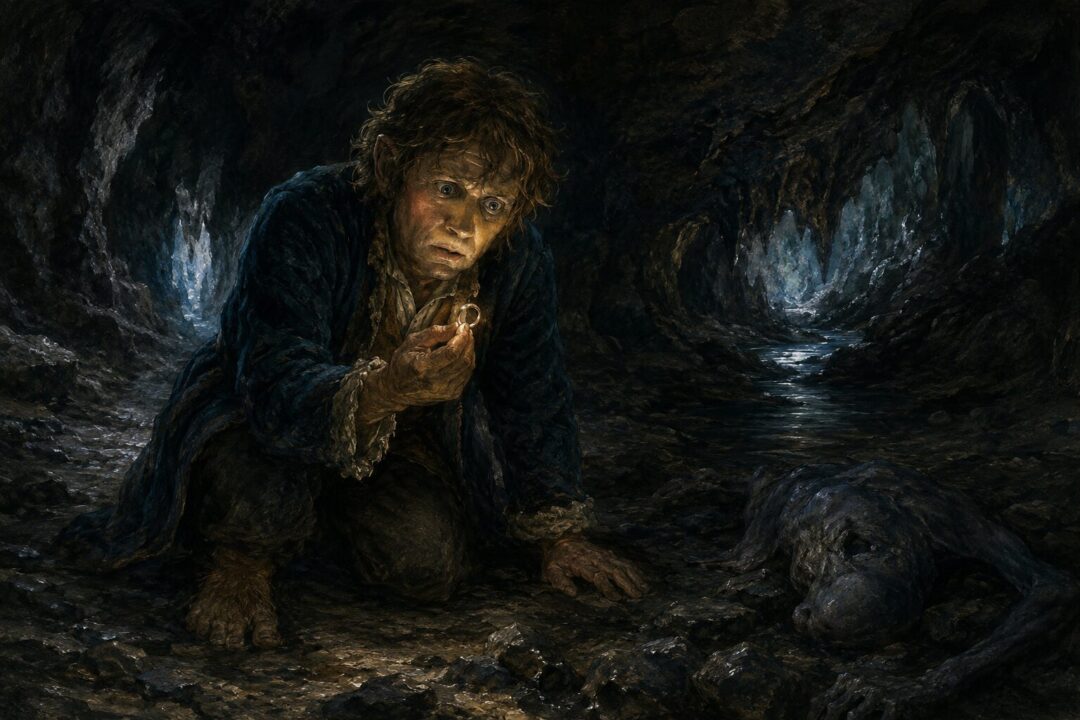
A small gold ring in a dark tunnel seems, at first, like the least heroic object in Middle-earth. It is not a sword reforged, a white tree flowering, or a king returning from exile. It is something lost, found by accident, hidden in a pocket, and lied about afterward. Yet the road to Sauron’s fall passes through that moment: Bilbo Baggins alone beneath the Misty Mountains, with Gollum between him and escape.
Bilbo did not set out to save the world. In The Hobbit, he set out reluctantly, as a hired burglar on Thorin Oakenshield’s quest to reclaim the Lonely Mountain. Even Gandalf’s larger concerns were not fully visible to Bilbo. But by the time the tale of the Ring reaches Rivendell in The Lord of the Rings, Bilbo’s adventure has become something more than a charming prelude. It has removed a dragon from the North, restored powers that would resist Mordor, brought the Ring out of hiding, and—most importantly—set in motion an act of mercy that Sauron could neither predict nor master.
Bilbo’s adventure did not defeat Sauron by strength. It prepared the way for Sauron’s fall by creating the only chain of events in which the Ring could be found, carried, pitied, inherited, and finally destroyed.
The Quest Was Smaller Than the War, but Not Separate from It
The Quest of Erebor begins as a Dwarven matter: Thorin wants his kingdom and treasure restored. But the wider history reveals that the Lonely Mountain was not merely a lost homeland. It stood in the North, near Dale, Mirkwood, and the lands through which enemies could move if Sauron returned in strength.
In Unfinished Tales, “The Quest of Erebor” gives Gandalf’s deeper anxiety: Smaug was not simply a dragon sitting on gold. He was a devastating power in a strategically dangerous place. Gandalf feared what might happen if Sauron made use of Smaug, or if the North remained broken when war came. Tolkien Gateway’s summary of that account notes Gandalf’s concern that Sauron might exploit the desolation around Erebor and threaten the northern passes and old lands of Angmar.
This does not mean Gandalf planned every consequence of Bilbo’s journey. The texts do not present him as seeing the entire future. But they do show that the adventure was never only about treasure. The North was vulnerable. Smaug’s presence left Erebor ruined and Dale destroyed. A dragon in that region, with Sauron rising again from Dol Guldur, was a danger far beyond Thorin’s personal claim.
Bilbo’s part appears absurdly small beside such forces. He is not a warrior-prince, loremaster, or captain. Yet Gandalf’s choice of Bilbo matters precisely because he is not another power-player. He enters the story from the margins, and that becomes one of the hidden rules of Sauron’s defeat: the great enemy is repeatedly undone by what he overlooks.
Smaug’s Death Changed the Shape of the North
Bilbo did not slay Smaug. Bard of Lake-town did that. Nor did Bilbo win the Battle of Five Armies by force. Still, Bilbo’s role in the quest helped bring about the conditions that led to Smaug’s death. He entered the Lonely Mountain, spoke with the dragon, discovered the bare patch in Smaug’s jewel-armored underside, and that knowledge reached Bard through the thrush.
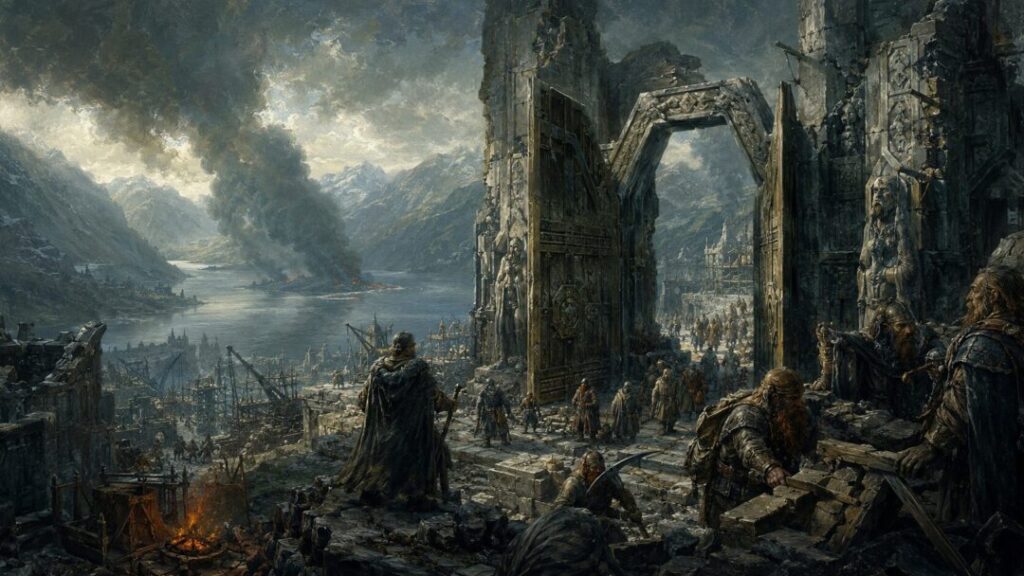
The result was not merely the death of a monster. Smaug’s fall allowed Erebor to be restored under Dáin Ironfoot, and Dale to be rebuilt under Bard and his successors. Those restored realms later mattered in the War of the Ring.
During Sauron’s final war, the conflict did not happen only around Minas Tirith and Mordor. The North also came under attack. Sauron’s forces struck Dale and Erebor, and King Brand of Dale and King Dáin II died before the gates of the Lonely Mountain. The survivors endured siege until news of Sauron’s fall broke the power of the enemy. Tolkien Gateway summarizes the northern war as one of Sauron’s simultaneous fronts, including attacks on Dale, Erebor, the Wood-elves, and Lothlórien.
Here the consequence of Bilbo’s adventure becomes clearer. Had Smaug remained in the Mountain, there would have been no strong Dwarven kingdom under Erebor, no restored Dale beside it, and no northern resistance in that form. The texts do not give us a full alternate history, so we should be cautious: they do not say exactly how Sauron would have used Smaug, or whether Smaug would certainly have obeyed him. But Gandalf’s fear was serious. A living dragon in the North, combined with Sauron’s return, would have been a disaster waiting to be exploited.
Bilbo’s adventure helped remove that disaster before the War of the Ring began.
The Ring Came Out of the Dark Because Bilbo Was Lost
The most world-changing part of Bilbo’s journey happens almost by accident. Separated from the Dwarves in the goblin tunnels, Bilbo finds a ring lying on the ground. He does not know what it is. Gollum has lost it. The Ring, hidden for centuries beneath the Misty Mountains, passes into Bilbo’s hand.
From Sauron’s perspective, this was catastrophic. The One Ring had been beyond his reach since Isildur lost it. While Gollum possessed it, it remained buried in darkness, unknown to the great powers. Once Bilbo found it and brought it back into the open world, the Ring began moving again. That movement was dangerous, but necessary. A Ring that remained hidden forever could not be destroyed.
Yet the manner of its finding is morally important. Bilbo does not win the Ring through murder, domination, or conquest. He finds it by chance, then uses it to escape. Later, under the Ring’s influence, he gives a false account of how he obtained it, claiming Gollum had meant to give it as a present. The Lord of the Rings corrects this and makes the earlier lie part of the Ring’s shadow over Bilbo. That matters because the Ring does not need to turn Bilbo into a tyrant to begin bending his honesty.
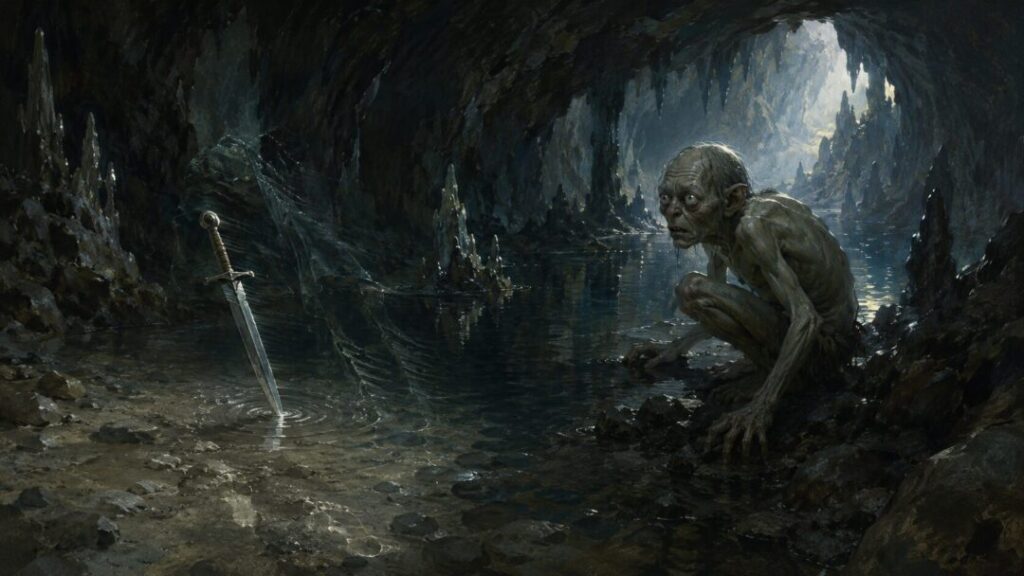
Still, Bilbo’s possession of the Ring is unlike Gollum’s. Gollum’s story begins in murder. Bilbo’s decisive moment is mercy.
Bilbo’s Pity Became a Weapon Sauron Could Not Understand
When Bilbo has the chance to kill Gollum, he does not. Gollum is dangerous, treacherous, and hunting him. Killing him would seem practical. But Bilbo sees his misery and spares him.
This mercy is one of the central hinges of the entire legend. In The Lord of the Rings, Gandalf later tells Frodo that Bilbo’s pity may rule the fate of many. That is not sentimental decoration. It is a structural truth of the story. Gollum survives because Bilbo refuses to kill him; Frodo later spares Gollum in part because he has learned from Gandalf’s interpretation of Bilbo’s mercy; and at the end, when Frodo can no longer surrender the Ring by his own will, Gollum’s presence at the Cracks of Doom becomes the terrible means by which the Ring is destroyed.
This does not make Gollum good. Nor does it mean his final act is noble. The text presents the destruction of the Ring as a convergence of pity, corruption, oath, struggle, and providence. Gollum bites the Ring from Frodo’s hand and falls with it. He does not freely choose to save Middle-earth. But he is there because mercy preserved him.
Sauron can calculate fear, greed, pride, and the desire for power. He can tempt, threaten, and dominate. What he cannot master is pity freely given to the undeserving. Bilbo’s mercy introduces into the story a kind of power that does not behave like power. It does not seize. It refuses to kill. And because it refuses, the final possibility remains open.
Bilbo Prepared Frodo Without Knowing the Burden
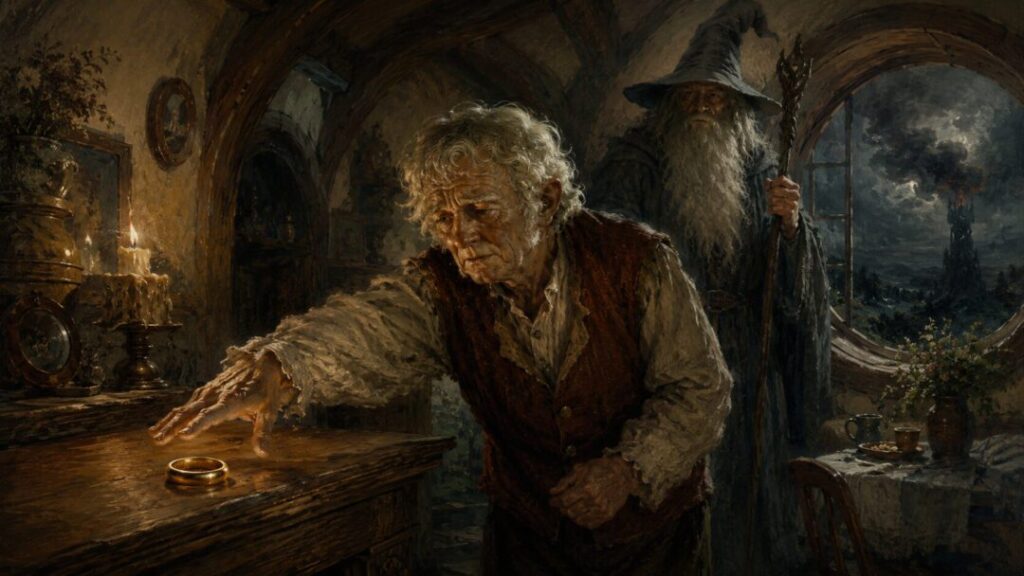
Bilbo also prepared the way for Sauron’s fall by becoming the Ring’s unlikely keeper before Frodo. He brought the Ring to the Shire, lived with it for decades, and eventually left it to Frodo. That last act was not easy. At his farewell party, Bilbo struggles to give it up, and Gandalf must press him hard. The moment shows how dangerous the Ring already is, even in the hands of a relatively humble hobbit.
But Bilbo does give it up. This is extraordinary. The texts treat voluntary surrender of the Ring as rare and morally significant. Bilbo is wounded by the act, but he manages it. Because he does, Frodo receives the Ring not by theft or murder, but through inheritance and trust.
Bilbo also gives Frodo more than an object. He gives him stories, language, curiosity, and a connection to the wider world beyond the Shire. Frodo’s ability to sit among Elves, listen to histories, and bear a burden larger than himself is not created by Bilbo alone, but Bilbo helps shape it. The Shire’s innocence is not enough by itself; Frodo also needs imagination, humility, and the ability to take old tales seriously.
Bilbo’s adventure opened a crack in the Shire’s walls. Through that crack came danger, but also preparation.
The Adventure Also Exposed the Ring’s Trail
There is a darker consequence too. Bilbo’s adventure helped bring the Ring into motion, but motion meant discovery. Gollum eventually left the mountains. Sauron learned of “Baggins” and “Shire.” The hunt for the Ring began to turn westward.
This means Bilbo’s adventure did not make the road safe. It made the final crisis possible. That distinction is crucial. If the Ring had stayed with Gollum, Sauron might have continued searching, and the West might have remained ignorant until too late. If the Ring had passed to a lord or warrior, it might have become a weapon of ruin. If Bilbo had killed Gollum, the final scene at Mount Doom would have lacked the very creature whose survival made destruction possible.
The path that actually occurs is narrow and morally strange. The Ring is found by someone small enough not to imagine conquest. It is carried away from darkness but not immediately revealed. It is surrendered, though painfully. It passes to Frodo. Gollum survives. And the final victory comes only after Frodo himself reaches the limit of his strength.
Bilbo’s adventure prepared the way not because Bilbo was flawless, but because his choices left room for grace where calculation would have closed it.
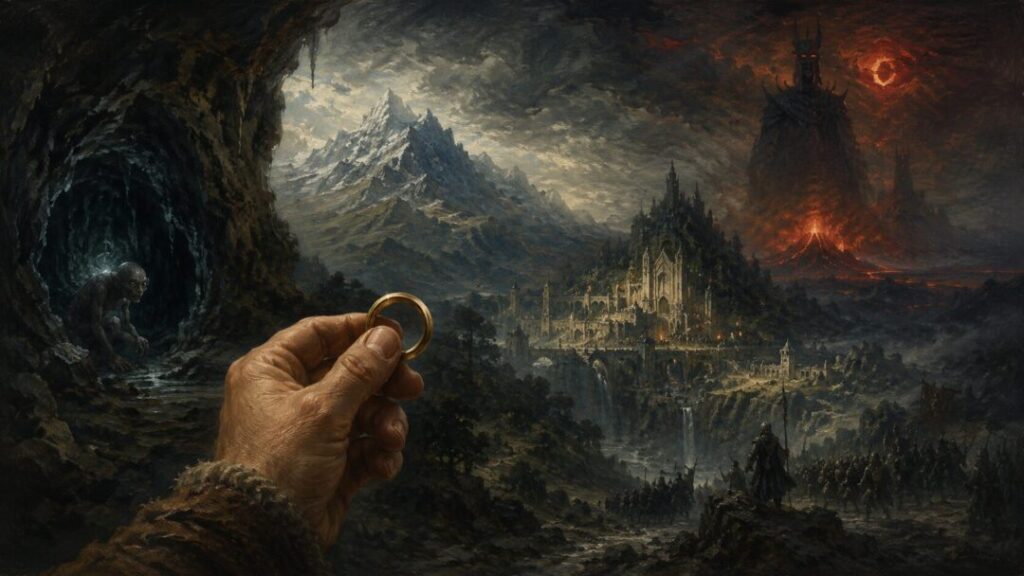
The Hidden Pattern: Small Hands Against the Great Eye
Sauron’s great weakness is not stupidity. He is ancient, cunning, and terrifyingly strong. His weakness is moral imagination. He assumes others will use power as he would use it. He fears rivals, weapons, kings, armies, and claimants. He does not truly understand the decision to destroy power rather than wield it.
Bilbo’s adventure is the first major sign of that hidden pattern. A hobbit enters a dragon’s lair without becoming a dragon. He finds the Ring without understanding it. He spares a wretched enemy. He later gives the Ring away. None of these acts looks like a military victory. Yet each one prepares the conditions for the only victory that can matter.
By the end of the Third Age, Sauron falls not because the West becomes stronger than Mordor in open force, but because the Ring reaches the Fire. That road begins long before Frodo and Sam climb Mount Doom. It begins in a comfortable hobbit-hole disturbed by a wizard, in a mountain held by a dragon, in a riddle-game under the earth, and in one small figure lowering his sword when killing would have been easier.
Bilbo’s adventure prepared the way for Sauron’s fall because it joined strategy to mercy. Smaug was removed from the North. Erebor and Dale rose again. The Ring came out of hiding. Frodo inherited both the burden and the example. And Gollum lived long enough to become, unwillingly and terribly, the last instrument in the Ring’s destruction.
The great irony is that Bilbo never understood the full weight of what he had done. That is fitting. In Middle-earth, the deepest turns of history often pass first through the hands of those who do not seek mastery. Bilbo wanted to get home. Because he did not want the world, he helped save it.
Sources & Notes
- J.R.R. Tolkien, Unfinished Tales, “The Quest of Erebor” — Gandalf’s later account of why Smaug and the ruined North mattered strategically when Sauron was rising again.
- J.R.R. Tolkien, The Hobbit, Chapter 5, “Riddles in the Dark” — Bilbo finds the Ring beneath the Misty Mountains and chooses not to kill Gollum when he has the chance to escape.
- J.R.R. Tolkien, The Lord of the Rings, Book I, Chapter 2, “The Shadow of the Past” — Gandalf connects Bilbo’s pity, the Ring’s passage to Frodo, and the possibility that Gollum still has a part to play.
- J.R.R. Tolkien, The Lord of the Rings, Book II, Chapter 2, “The Council of Elrond” — the Ring’s history is brought into the open at Rivendell, turning Bilbo’s private adventure into part of the war against Sauron.
- J.R.R. Tolkien, The Lord of the Rings, Book VI, Chapter 3, “Mount Doom” — Gollum’s final seizure of the Ring completes the chain of mercy and accident that Sauron failed to foresee.