When Aragorn, Legolas, and Gimli find Boromir dying beneath the trees of Parth Galen, one detail stands beside the fallen captain like a final testimony: his horn is cloven in two.
It is easy to remember the Horn of Gondor as a striking accessory — a warrior’s signal instrument, a noble flourish from the heir of the Stewards. But in the texts, Boromir’s great horn carries far more weight than that. It speaks of lineage, duty, political identity, isolation, and even the tragic limits of strength.
The horn is not merely something Boromir carries.
It is one of the clearest symbols of who he believes himself required to be.
The Great Horn of Gondor Was an Heirloom of Office
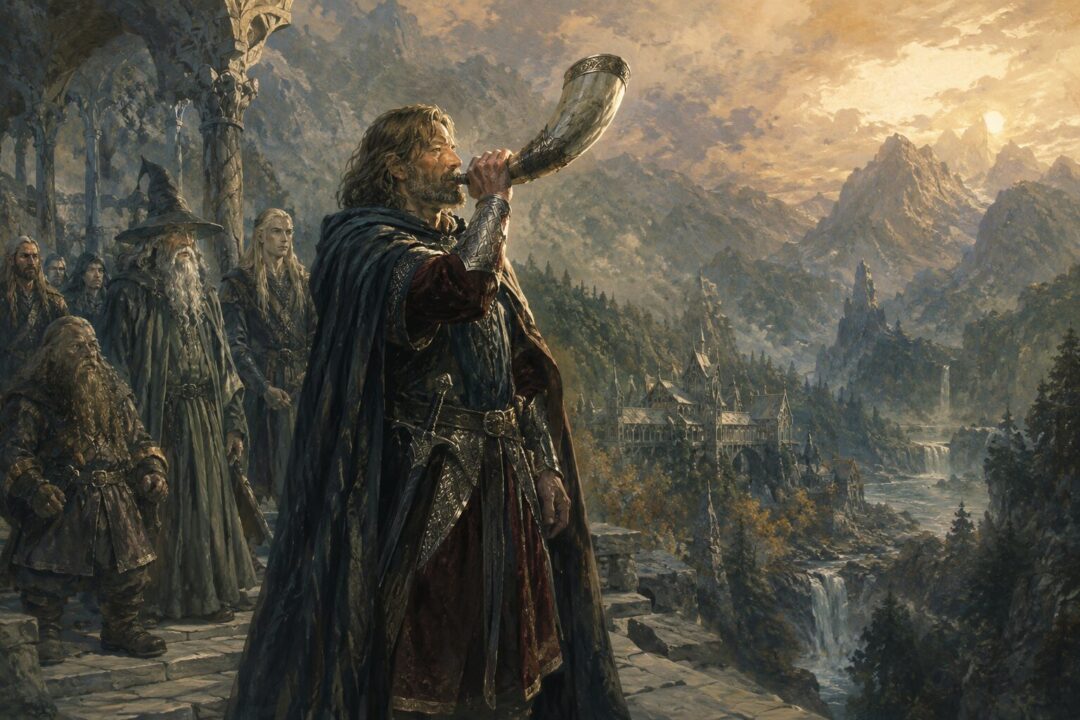
The Horn of Gondor is introduced in The Fellowship of the Ring with unusual care. Boromir bears “a great horn tipped with silver” at his side, and the object is explicitly linked to his house and rank.
This is not a random soldier’s tool.
The horn belongs to the eldest son of the Steward. In Gondor’s political culture, that matters enormously.
By the late Third Age, Gondor no longer has a king. The Stewards rule “until the king returns,” but centuries have passed without that return. The office has become hereditary, powerful, and burdened by accumulated expectation. Boromir is not simply Denethor’s son; he stands as the likely future leader of Gondor’s ruling house.
The horn marks that position.
The text preserves a tradition surrounding it: if the horn is blown anywhere within the bounds of Gondor, aid should answer. That idea reveals something profound about Gondorian identity. The horn is not only ceremonial prestige. It represents an ancient bond between ruler, realm, and people.
A call sounded from the Steward’s heir is supposed to mean something.
Someone should come.
A Signal of Authority — and a Reminder of Gondor’s Old Confidence
In older warfare, horns are practical objects: they rally troops, communicate commands, and announce arrival or challenge.
Boromir’s horn does all of those things, but it also carries symbolic authority.
At Rivendell, Boromir blows it before setting out from the Council. Elrond is not pleased. He warns that such signals announce the Fellowship’s movements to enemies.
Boromir answers in words that reveal much about his worldview. He says he will not go “like a thief in the night.”
That line matters.
Boromir does not think like a ranger operating in hidden wilderness or like a Ring-bearer moving through secrecy and sacrifice. He thinks like a captain of Gondor.
Open strength, declared purpose, visible courage — these are virtues in his moral framework.
And they are not foolish virtues in themselves. Gondor has survived generations of war precisely because people like Boromir stood openly against the Shadow.
But the Quest of the Ring requires a different logic.
Stealth must succeed where military honour cannot.
The horn therefore becomes an early sign of tension between Boromir’s inherited values and the impossible demands of the mission.
He is not wrong to value courage.
He is tragically in the wrong kind of story for courage alone to be enough.

The Horn Reveals Boromir’s Deep Need to Be Recognized
One overlooked feature of Boromir’s characterization is how strongly he is tied to public duty and visible responsibility.
He is not inwardly detached like Aragorn. He is not protected by Elvish distance or hobbit simplicity.
Boromir lives under expectation.
He arrives in Rivendell after a dangerous journey undertaken because of a troubling dream shared with his brother. He comes carrying Gondor’s fears: the pressure of Mordor’s growing strength, the defence of Minas Tirith, and the exhaustion of a realm that feels abandoned by much of the wider world.
His horn fits that psychology.
A horn is heard. It announces presence. It calls allies. It assumes response.
In a subtle way, this matches Boromir’s emotional position throughout the narrative.
He repeatedly thinks in terms of armies, walls, victories, defence, leadership, and the practical obligations of rulers. When he questions whether the Ring could be used against Sauron, the argument grows from that same burdened mindset.
He is not seeking private domination for pleasure.
He sees a city under threat.
He sees fathers, sons, soldiers, and civilians who may die if strength fails.
That does not excuse his attempt to seize the Ring from Frodo. But the horn helps illuminate the mental world from which that temptation emerges: a world in which leaders are expected to answer danger with force and decisive action.
The Broken Horn Is One of the Most Important Objects at Boromir’s Death
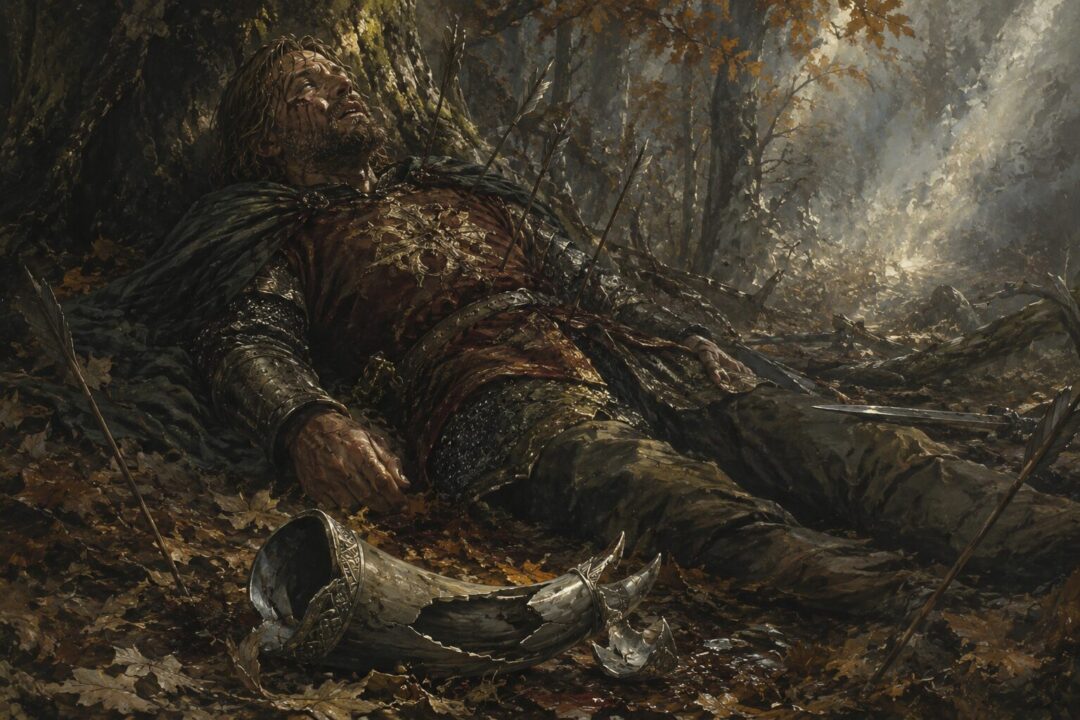
After Boromir’s last battle, Aragorn finds him pierced with many arrows.
Nearby lies the broken horn.
This detail is not incidental decoration. The narrative gives it significance.
The horn has been “cloven in two,” and its fragments are later sent down the Anduin. Eventually they reach Denethor in Minas Tirith.
The symbolic force of this is hard to overstate.
The heirloom of the Steward’s house — the instrument that promises response, authority, and connection to Gondor — returns home shattered.
Not with triumphant news.
Not carried by a victorious son.
Broken.
Yet the horn’s destruction is not a sign of cowardice or failure in the simple sense.
Boromir dies defending Merry and Pippin against overwhelming attack. Whatever moral collapse occurred when he tried to take the Ring, his final actions matter deeply in the text.
Aragorn himself acknowledges this.
Boromir regains moral clarity.
He confesses what he has done.
He asks forgiveness.
And he dies still fighting.
The broken horn therefore reflects both tragedy and restoration.
Boromir could not remain unfallen. But neither does he remain defined solely by his fall.
Why No Help Came When Boromir Blew the Horn
One of the most painful ironies surrounding the Horn of Gondor lies in the old tradition attached to it.
If blown within Gondor’s borders, help should come.
Yet Boromir’s last sounding brings no rescue.
Several careful distinctions matter here.
First, Boromir dies at Parth Galen beside Nen Hithoel, far from Minas Tirith and outside Gondor proper. The old promise concerning the horn does not mechanically apply there.
But the emotional symbolism remains powerful.
Boromir sounds the horn in desperate battle.
Aragorn hears it from afar.
The sound comes urgently, repeatedly, and then ceases.
That sequence carries tremendous narrative weight.
A call goes out.
Aid is delayed.
The voice falls silent.
The moment reflects one of the recurring realities of Middle-earth: courage does not guarantee timely rescue.
Sometimes allies arrive too late.
Sometimes distance, fractured politics, geography, or sheer circumstance intervene.
Gondor itself knows this truth intimately. Its long history is full of dwindling borders, isolated outposts, and defensive wars fought under mounting pressure.
Boromir’s horn, in that final moment, becomes almost unbearably poignant — a symbol of the human desire to believe that duty answered with courage must surely summon help.
But Middle-earth does not always grant that assurance.
The Horn’s Journey Back to Minas Tirith Carries a Terrible Message
The broken pieces of Boromir’s horn do not vanish with him.
They travel.
This matters because objects in Tolkien’s legendarium often preserve memory and meaning beyond the lives of their owners.
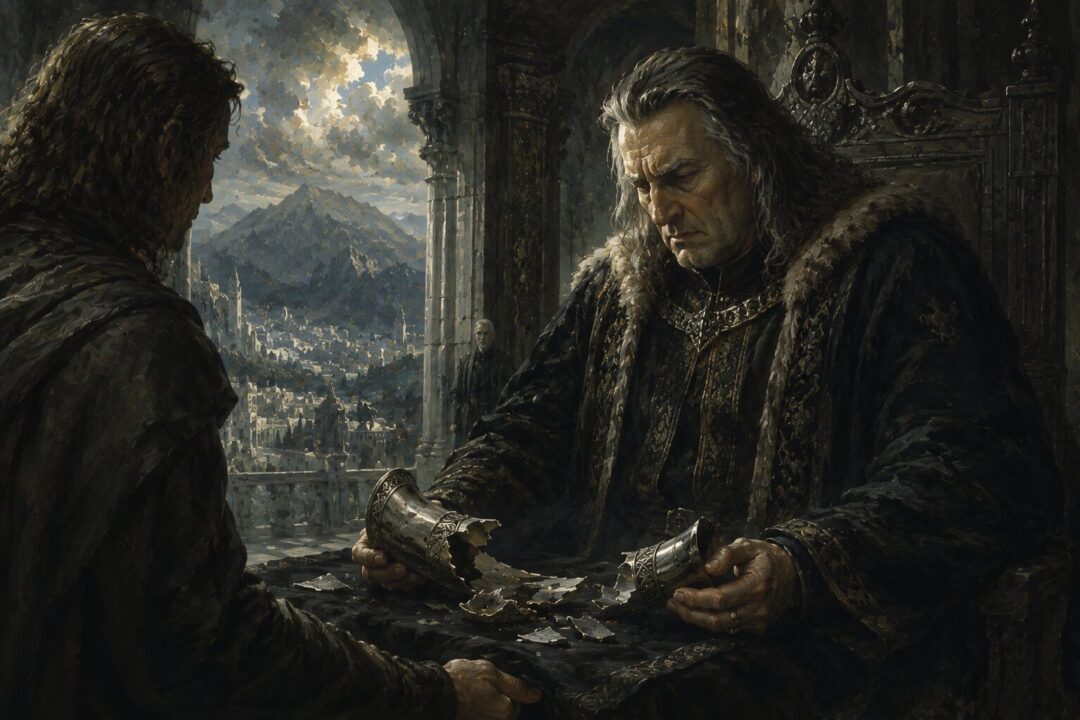
When the fragments are recovered downstream and delivered to Denethor, they become evidence more devastating than rumour.
Denethor does not yet possess the full story.
But he knows what the shattered horn signifies.
His son is gone.
The old order of succession is wounded.
The house of the Steward has suffered a loss that cannot be hidden behind formal titles or military language.
The detail also sharpens the contrast between Boromir and Faramir.
Boromir’s martial inheritance is visibly broken.
Faramir — less celebrated by Denethor, more inwardly reflective, less eager for displays of military glory — remains.
The texts never reduce this contrast into a simplistic lesson that one brother represents “bad strength” and the other “good wisdom.” Both are brave. Both love Gondor.
But the horn’s destruction underscores that the future cannot be secured merely by repeating inherited models of power and war.
Gondor’s survival will ultimately require humility, healing, renewal of kingship, and alliances broader than martial pride alone.
Boromir’s Horn Represents the Tragedy of Noble Strength in the Third Age
The Horn of Gondor is memorable because it feels heroic.
And it is heroic.
But it is also mournful.
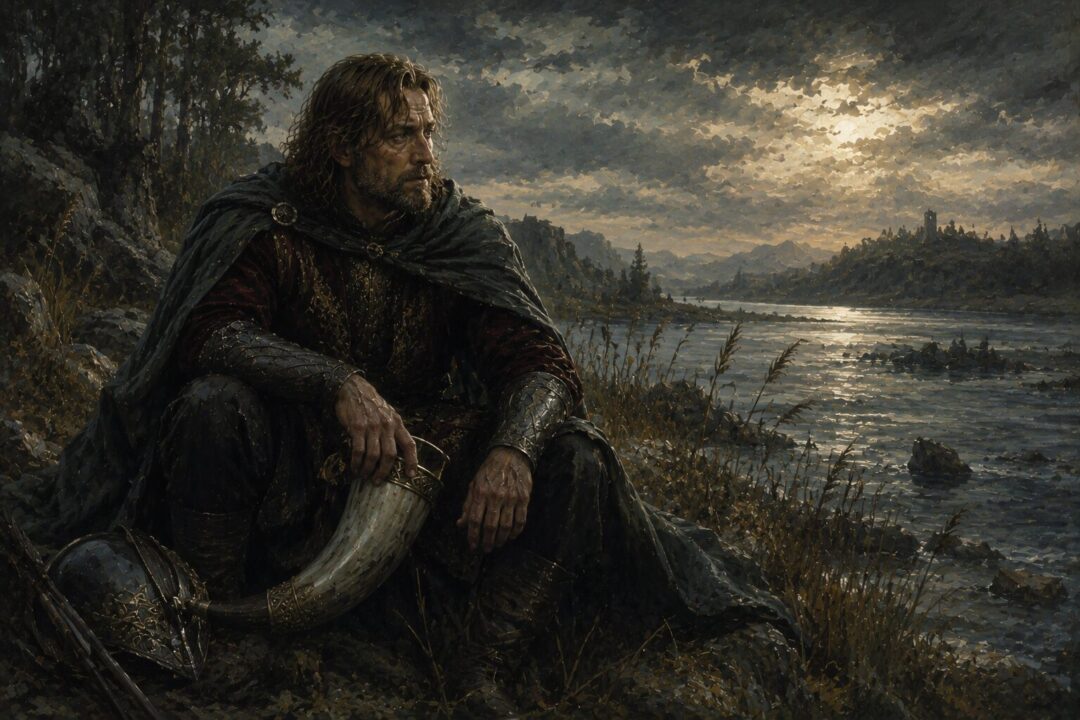
It belongs to a civilization fighting decline, to a warrior raised under relentless obligation, and to a political culture built around endurance against overwhelming darkness.
Boromir does not misunderstand courage.
He understands it too well.
His tragedy is that courage, lineage, military honour, and visible authority — the very virtues embodied by his horn — are not sufficient to solve the crisis facing Middle-earth.
The Ring cannot be mastered through stronger leadership.
Mordor cannot be defeated merely by louder declarations of resolve.
The old symbols still matter, but they cannot carry the entire burden.
That is why the broken horn lingers in memory.
Not because it looked impressive hanging at a warrior’s side.
But because it tells the story of a man who tried to answer impossible pressure with the tools his world had taught him to trust — and who, in losing and repenting, revealed both the greatness and the limits of Gondor’s noblest son.
Sources & Notes
- J.R.R. Tolkien, The Lord of the Rings, Book II, ch. 3 “The Ring Goes South”: Boromir’s silver-tipped horn, his proud sounding of it before departure, and Elrond’s warning about open signals.
- J.R.R. Tolkien, The Lord of the Rings, Book III, ch. 1 “The Departure of Boromir”: Boromir’s last stand, confession to Aragorn, and the great horn “cloven in two” beside him.
- J.R.R. Tolkien, The Lord of the Rings, Book IV, ch. 5 “The Window on the West”: Faramir’s vision of Boromir’s funeral boat and the broken horn fragments returning down Anduin.
- J.R.R. Tolkien, The Lord of the Rings, Book V, ch. 1 “Minas Tirith”: Denethor’s grief and the received horn confirm how Boromir’s death strikes the House of the Stewards.
- J.R.R. Tolkien, The Lord of the Rings, Appendix A, “Gondor and the Heirs of Anárion”: background for the hereditary Stewardship and its long rule “until the king returns.”