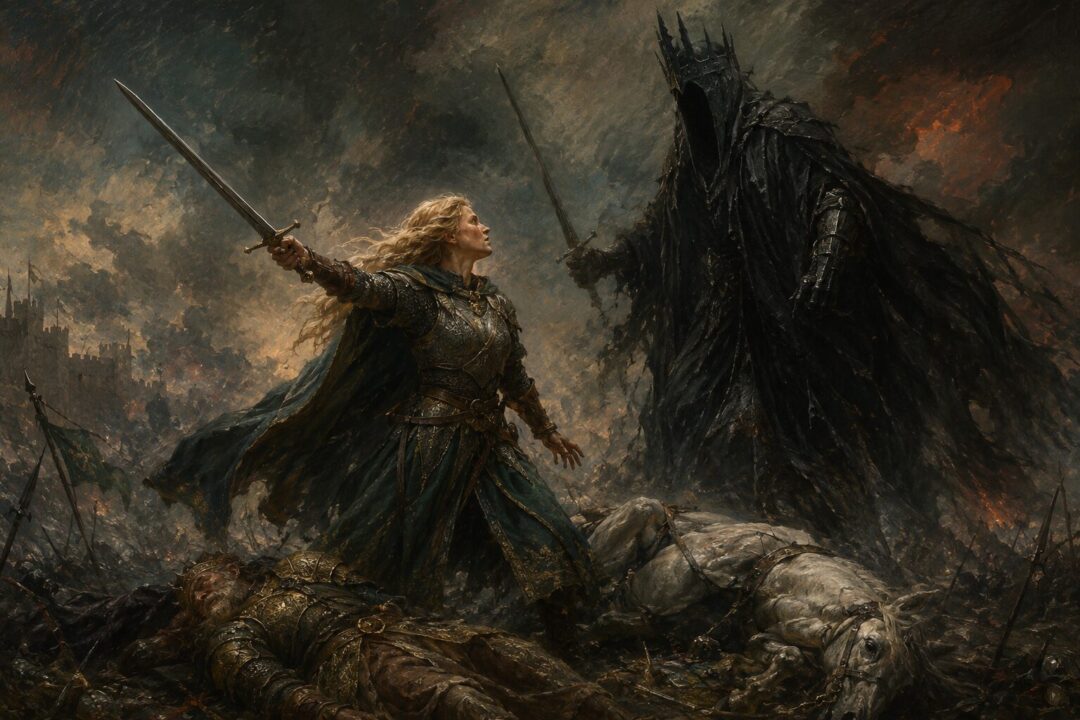
The Witch-king’s fall is often remembered as one bright line: “I am no man.” It is a perfect moment—sharp, defiant, unforgettable. Yet in the book, Éowyn’s victory is not merely a clever loophole in a prophecy. It is the meeting point of despair, loyalty, hidden courage, ancient craft, and the Enemy’s fatal misunderstanding of the small and the overlooked.
On the Pelennor Fields, Éowyn does not ride out because she expects glory. She rides as Dernhelm because the life appointed to her has become unbearable. Her great deed is born not from simple confidence, but from grief, frustration, and a longing to do something that matters before darkness consumes all.
The Prophecy Was Never a Simple Magical Rule
Long before the Pelennor Fields, Glorfindel foretold that the Witch-king would not fall “by the hand of man.” That prophecy was not a battlefield instruction manual. It did not explain how the Nazgûl-lord would die, nor did it say that only a woman could kill him. It was a doom, mysterious and easily misunderstood.
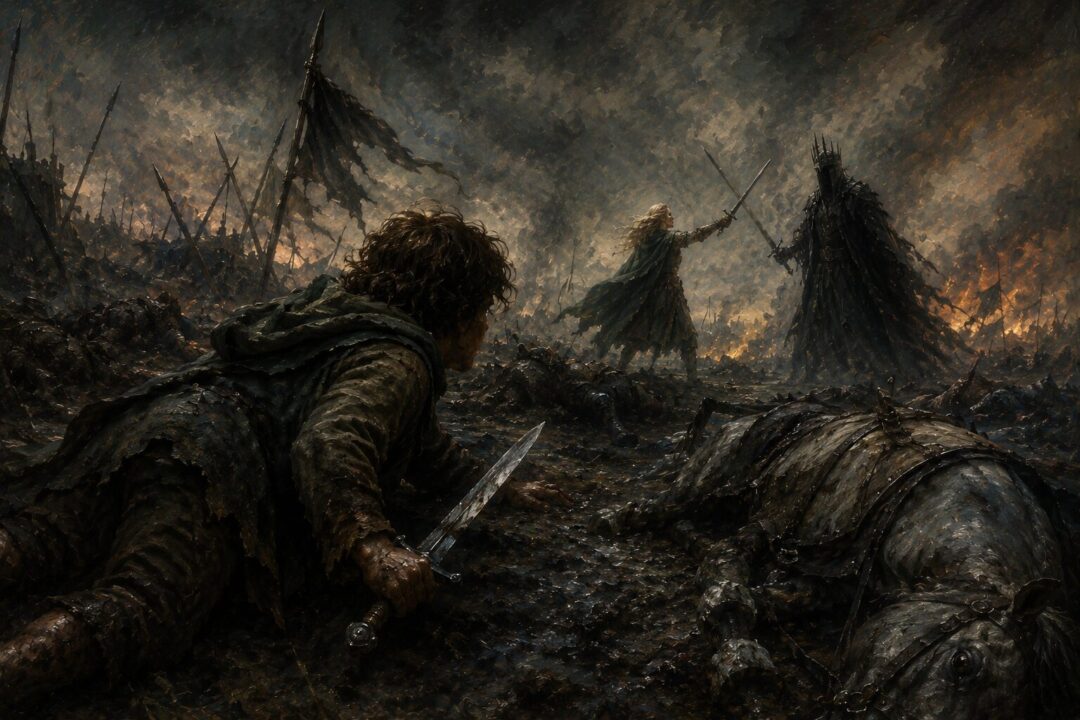
The Witch-king seems to take it as a shield. When Éowyn stands between him and Théoden, he says that no living man may hinder him. But his confidence is part of his ruin. He thinks in terms of domination: kings, warriors, fear, rank, and power. He does not imagine that the hidden rider before him is a woman of Rohan, nor that a hobbit crawling in terror nearby will become part of his undoing.
That is why the scene is richer than a wordplay victory. Éowyn’s answer exposes the narrowness of the Witch-king’s imagination. He can inspire terror in armies, but he cannot see the worth of those he dismisses.
Éowyn Stands for Théoden Before She Stands for Herself
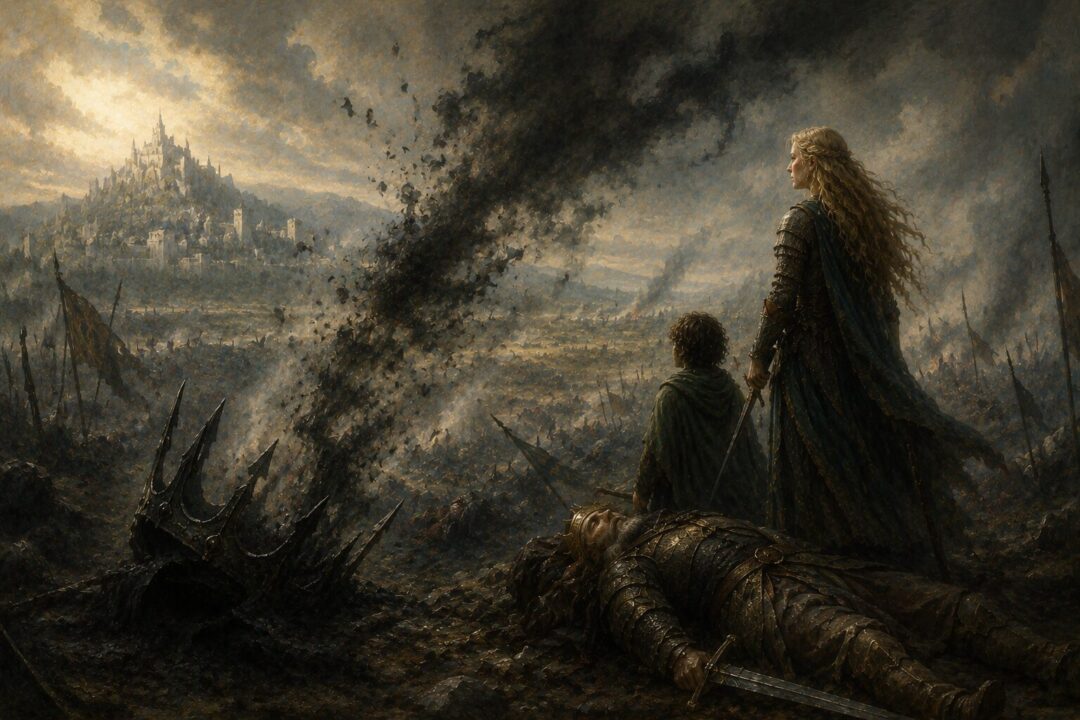
Éowyn’s challenge is not first a declaration of identity. It is an act of protection. Théoden lies crushed beneath Snowmane, and the Lord of the Nazgûl comes to claim him. Éowyn stands between them.
That matters. Her courage is not abstract. She does not confront evil because she has found a safe way to defeat it. She confronts evil because someone she loves is helpless. Her words are rooted in kinship: Théoden is her lord and foster-father, and she will not let his body be dishonored.
This makes her victory morally different from a duel for fame. Éowyn has long desired renown, but at the crucial moment her action becomes service. She does not step forward as a conqueror. She steps forward as a shield.
Merry’s Part Is Essential
Éowyn does not defeat the Witch-king alone. Merry’s Barrow-blade is crucial in the text. Forged long before in the wars against Angmar, it was made by enemies of the Witch-king’s realm, and its blow breaks the spell binding his unseen sinews to his will. Only then can Éowyn strike the final blow.
This does not diminish Éowyn. It deepens the victory. The Witch-king falls because two people he would never truly regard as threats act together: a woman disguised as a rider and a hobbit almost paralyzed by fear.
Middle-earth often turns on such unlikely cooperation. Great evil is not overcome only by the obviously mighty. It is resisted by mercy, loyalty, friendship, and sudden courage in those history might overlook.
The Barrow-blade Brings the Past Into the Present
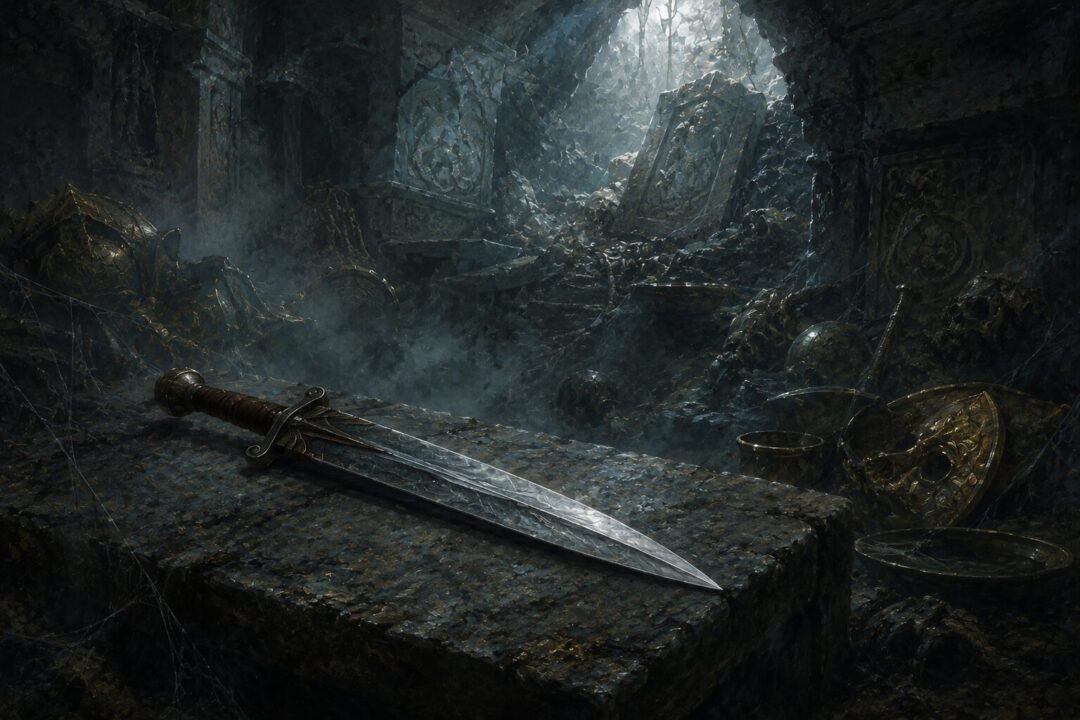
Merry’s weapon is not random. It comes from the Barrow-downs, from a hoard tied to the old wars of the North. In the Pelennor scene, ancient resistance returns at the exact moment it is needed.
This gives the Witch-king’s death a long historical echo. The evil that once ruled Angmar is struck by a blade made against that very darkness. The past has not vanished; it has been waiting in strange places, carried by a hobbit who never sought such a role.
That is one of the hidden beauties of the moment. Éowyn’s courage, Merry’s pity, Théoden’s fall, the old blade, and Glorfindel’s prophecy all converge. The victory is personal, but also historical. It is not a neat trick. It is a knot of providence, memory, and courage.
Éowyn’s Despair Is Part of the Scene
Éowyn’s bravery should not be flattened into simple empowerment. Before this moment, she is deeply wounded by confinement, hopelessness, and the fear of being left behind while others act. She longs for deeds, but also for death in battle. Her courage is real, but it is tangled with despair.
That makes the Pelennor victory tragic as well as triumphant. Éowyn defeats a deathly servant of Sauron, yet she herself has been drawn toward death. Her confrontation with the Witch-king externalizes the darkness already pressing on her spirit.
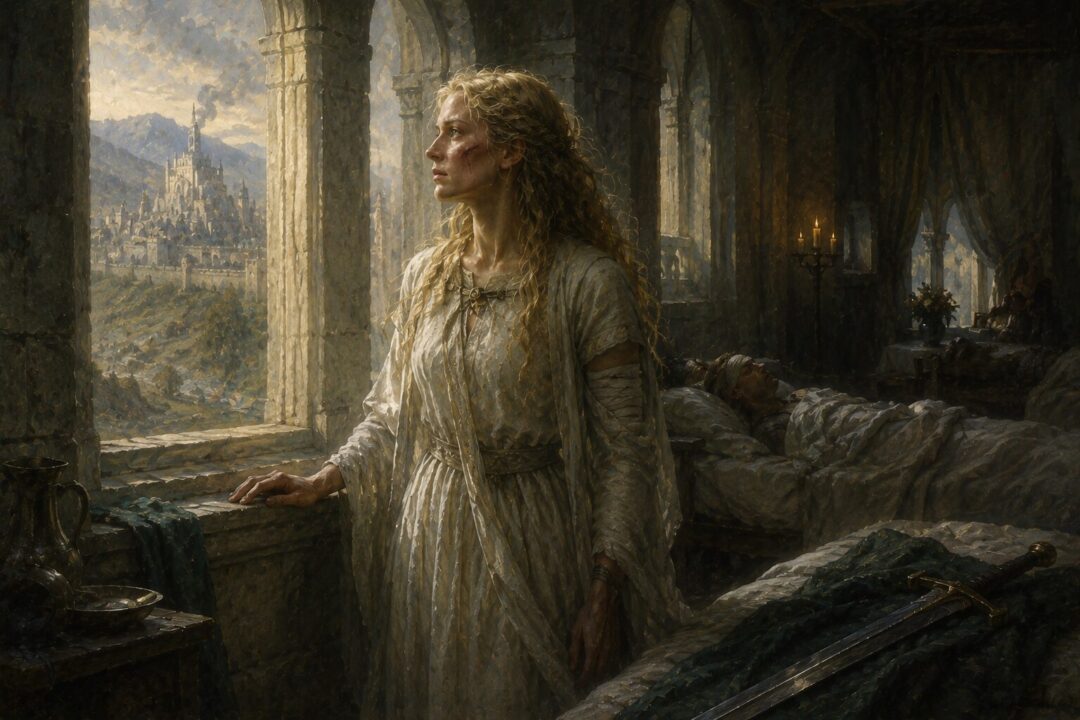
The victory does not instantly heal her. Afterward she falls into the Black Breath and is brought to the Houses of Healing. There, her story continues beyond the battlefield. The defeat of the Witch-king is not the end of Éowyn’s arc; it is the breaking point that makes healing possible.
“No Man” Also Means the Enemy Misjudged the World
The Witch-king’s mistake is not merely grammatical. He misjudges the moral structure of Middle-earth. The Enemy repeatedly overlooks what seems small, hidden, humble, or outside the expected patterns of power.
Sauron does not imagine that someone would seek to destroy the Ring rather than wield it. The Witch-king does not imagine that a woman and a hobbit could bring him down. Evil in Tolkien’s world often understands appetite and fear better than love, pity, or self-sacrifice.
Éowyn’s answer, then, is not just “you forgot about women.” It is also: you forgot about loyalty. You forgot about pity. You forgot about those whom the proud do not count.
The Victory Belongs to More Than Strength
Éowyn is strong, but the scene does not reduce her to strength. She is afraid, wounded, defiant, noble, reckless, loving, and desperate. Merry is terrified too, yet pity moves him when courage alone might fail. Their victory comes through imperfect people acting at the edge of their endurance.
That is why the Witch-king’s fall feels so powerful. It is not the triumph of invulnerability over invulnerability. It is the triumph of the vulnerable over terror.
Éowyn can be hurt. Merry can be crushed by fear. Théoden can die. The Barrow-blade can perish. Nothing about the scene is clean or costless. But because they can suffer, their courage matters.
The Aftermath Changes the Meaning
If Éowyn’s story ended with the Witch-king’s fall, it might seem to glorify death-seeking heroism. But the Houses of Healing change the meaning. Éowyn survives, and survival becomes part of her victory.
Her later turn toward healing and life does not erase her warrior deed. It completes it. She has faced the lord of death and lived, but she must still choose what to do with life afterward. That choice is just as important as the sword-stroke.
The triumph on the Pelennor is therefore not only about killing an enemy. It is about opening a path out of despair. Éowyn’s greatest victory is not that she proves she can die bravely. It is that she eventually learns she may live fully.
Why the Moment Still Matters
“I am no man” remains iconic because it is true in the immediate scene. Éowyn is not the kind of opponent the Witch-king expected. But the full power of the moment lies beneath the line.
She wins because she stands for the helpless. Merry wins because pity overcomes paralysis. The old blade wins because forgotten histories still matter. The prophecy is fulfilled because evil mistakes mystery for certainty. The Witch-king falls because he cannot imagine a world where the overlooked become decisive.
Éowyn’s victory is about more than identity. It is about hidden worth. It is about the courage of those denied a place in the songs until the hour comes when no one else can stand. It is about the limits of terror, the failure of pride, and the strange mercy by which Middle-earth’s greatest turns often come through those the Shadow never thought to fear.
Sources & Notes
- J.R.R. Tolkien, The Lord of the Rings, Appendix A, “Gondor and the Heirs of Anárion” — Glorfindel’s prophecy that the Witch-king would not fall by the hand of man.
- J.R.R. Tolkien, The Lord of the Rings, Book V, Chapter 6, “The Battle of the Pelennor Fields” — Éowyn/Dernhelm’s stand before Théoden and the Witch-king’s challenge.
- J.R.R. Tolkien, The Lord of the Rings, Book V, Chapter 6, “The Battle of the Pelennor Fields” — Merry’s Barrow-blade breaks the Witch-king’s spell before Éowyn’s final stroke.
- J.R.R. Tolkien, The Lord of the Rings, Book I, Chapter 8, “Fog on the Barrow-downs” — the hobbits receive ancient blades from the Barrow-downs, giving Merry’s weapon its historical weight.
- J.R.R. Tolkien, The Lord of the Rings, Book V, Chapter 8, “The Houses of Healing” — Éowyn’s despair, the Black Breath, and the turn from death-seeking toward healing and life.