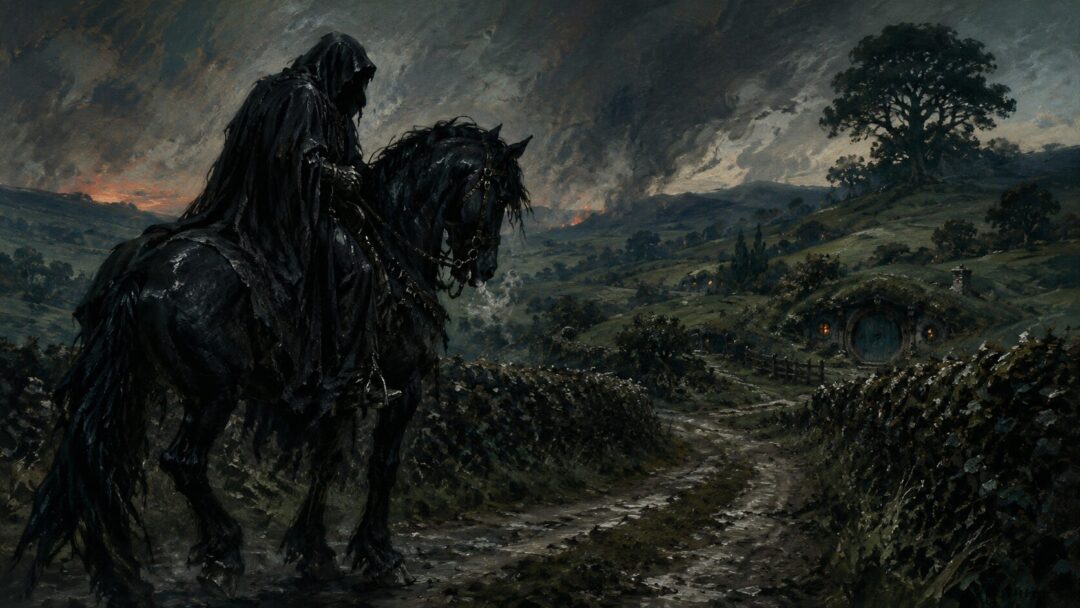
A Black Rider on a dark road should feel like the end of all hope. By the time the War of the Ring reaches Minas Tirith, the Nazgûl are not merely servants of Sauron but weapons of despair: winged shadows above armies, voices that break courage, a terror that seems almost larger than flesh. Yet their first appearance in the Shire is strangely awkward.
They do not sweep into Hobbiton with perfect knowledge. They ask questions. They follow lanes. They miss Frodo by inches. One of them stops near the hobbits and seems to sniff rather than see. For a while, these “most terrible servants” of the Enemy look less like all-knowing demons and more like hunters sent into a country they barely understand.
That contradiction is not a mistake. It reveals one of the most important hidden rules of Tolkien’s world: evil may be powerful, ancient, and terrifying, but it is not automatically wise. The Nazgûl are dreadful because of what they are. In the Shire, they are limited because of how they must operate.
The First Terror Is Not Battle, but Uncertainty
The Black Riders enter the early chapters of The Lord of the Rings as a mystery before they become a revealed horror. Frodo does not yet understand them. The Shire does not understand them at all. They appear as black-clad strangers asking after “Baggins,” unsettling ordinary hobbits by their mere presence.
That is crucial. In the Shire, the Nazgûl are not yet battlefield commanders or open instruments of ruin. They are scouts and hunters. Their task is not to destroy a city, but to find a person: a small hobbit in a land Sauron has neglected, carrying a Ring that has not yet been openly claimed.
Their weakness here is practical before it is mystical. They have a name and a place: Baggins, Shire. That sounds precise until one remembers what the Shire is from Mordor’s point of view. It is distant, obscure, politically insignificant, and inhabited by a people Sauron has not taken seriously. The Enemy knows enough to send the Nine westward, but not enough to make the hunt effortless.
This is why the early Shire scenes are so tense. The danger is enormous, but the net is imperfect. The Riders are close, but not omniscient. Frodo survives not because the Nazgûl are harmless, but because their information is incomplete, their senses are strange, and their prey moves through a country that still belongs to ordinary life: gardens, lanes, ferries, inns, and chance kindness.
“Blind” Does Not Mean Powerless
The idea that the Nazgûl were “blind” in the Shire needs careful wording. Tolkien does not present them as blind in the ordinary physical sense. They ride horses, follow roads, question people, and navigate real landscapes. But their way of perceiving the world is not like the sight of living Men.
Strider’s explanation after Weathertop is one of the clearest guides. The Ringwraiths do not see the world of light as ordinary people do. Living shapes cast a kind of shadow in their minds, and their power of perception is stronger in darkness than under the noon sun. That single detail explains much of their early behavior.
In daylight, especially in the homely world of the Shire, they are not at their best. They are wraiths, beings pulled deeply into the Unseen world, forced to operate in the Seen world through cloaks, horses, weapons, and servants. Their black garments give form to what otherwise would be invisible. Their horses give them speed and practical contact with the road. But their essential nature is not fully at home in ordinary sunlight.
That makes their sniffing and searching deeply unsettling. It is not comic incompetence. It is the image of a creature whose senses are misaligned with the world it is hunting through. The Rider near the hidden hobbits is terrifying precisely because he is close enough to feel them, smell them, or sense something of the Ring’s nearness, yet not able simply to look down and say, “There he is.”
Why the Ring Did Not Give Them a Perfect Trail
A common question follows: if the Nazgûl were servants of Sauron and bound to the Rings of Power, why could they not simply sense the One Ring?
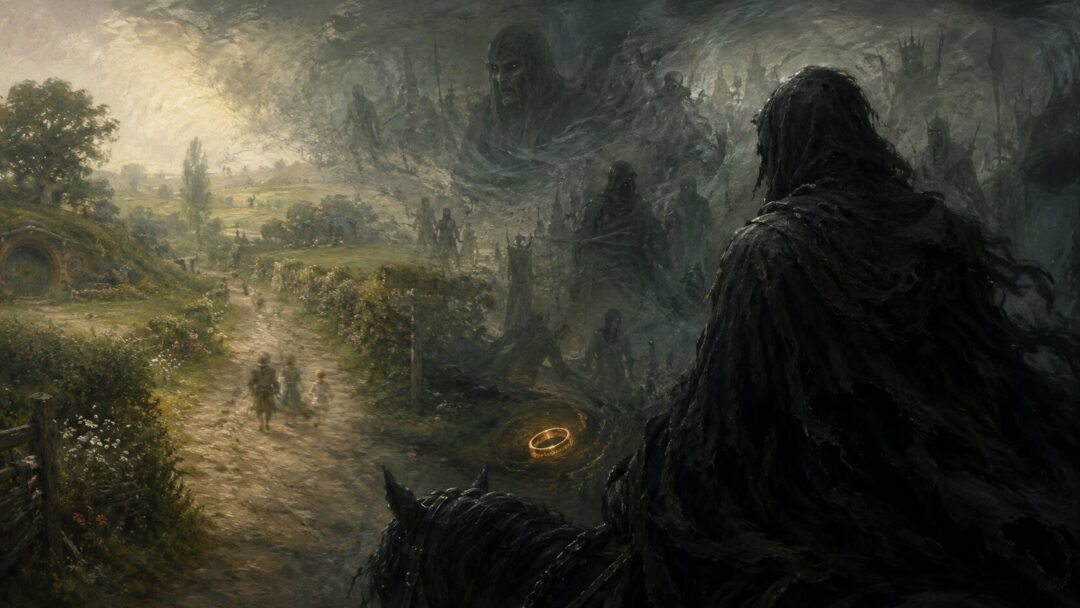
The answer seems to be that the Ring creates attraction, pressure, and peril, not a clean magical map. The Nazgûl are drawn to it and become more dangerous when Frodo uses it, but they do not possess an effortless location spell. When Frodo puts on the Ring at Weathertop, the world shifts. He sees the Ringwraiths more clearly in their own mode of being, and they become far more immediate and deadly to him. But before that, while the Ring is hidden and unworn, the hunt remains uncertain.
This matters thematically. The Ring is not just an object broadcasting its position. It is a willful and corrupting power. It works through temptation, fear, exposure, and choices. It betrays its bearer at key moments, but not always in the same way. In the Shire, Frodo feels the desire to put it on when the Black Rider approaches. That urge is one of the most frightening parts of the scene. The danger is not only that the Nazgûl may find him; it is that the Ring may help them by turning Frodo’s own fear against him.
So the Nazgûl are not blind because the Ring is weak. They are “blind” because the Ring has not yet been openly revealed, because Frodo has not yet fully entered their world, and because their bond to the Ring is not the same thing as complete knowledge.
The Shire Was a Bad Hunting Ground for Evil
The Shire also defeats the Nazgûl in a quieter way: it is not built for Sauron’s imagination.
Mordor understands power, fear, command, torture, tribute, and war. The Shire runs on family names, gossip, local roads, inherited holes, ferries, meals, and suspicion of outsiders. To Sauron, “Baggins” may sound like a useful answer. In the Shire, it is a name embedded in a social web. Who is asking? Which Baggins? Why? Where has he gone? What do the neighbors know, and what will they say?
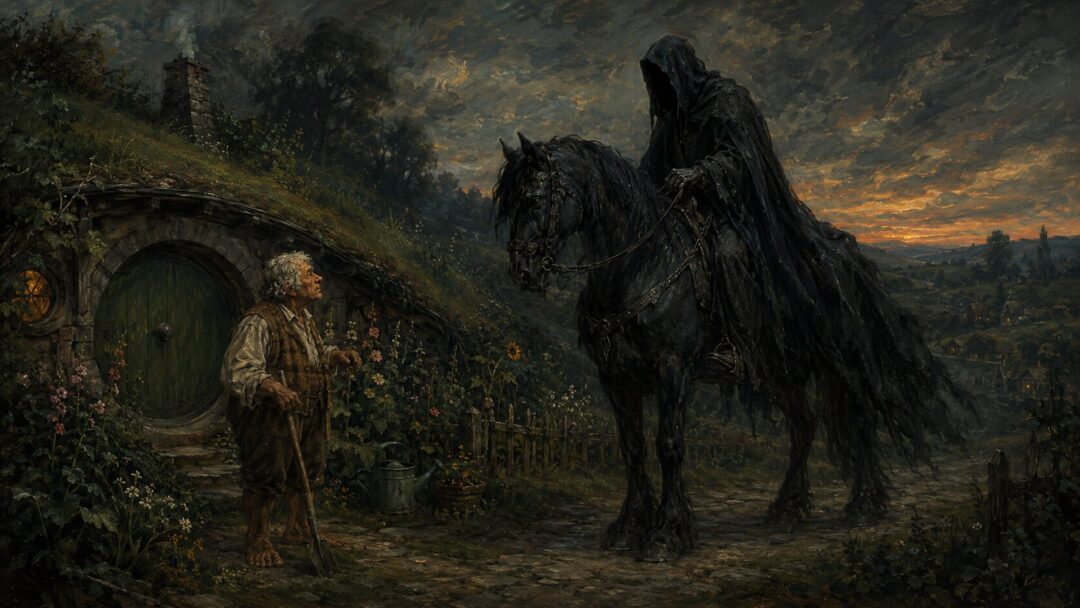
The Black Riders can frighten hobbits, but fear is not always the same as efficient intelligence. They disturb the Gaffer, alarm the countryside, and press toward Hobbiton and Buckland. Yet their very strangeness makes them conspicuous. They are not subtle in a land where a strange rider asking strange questions is remembered immediately.
There is a hidden irony here. The Shire’s innocence does not make it strong in military terms. It could not withstand open conquest. But its smallness, ordinariness, and obscurity delay the Enemy at the exact moment when delay matters. Sauron’s servants are mighty, but they enter a world of hedges, byways, and local knowledge. For once, the great machinery of darkness must depend on asking directions.
Khamûl and the Limits of the Hunt
Unfinished Tales adds another important layer to the hunt. The Nazgûl do not all operate with identical effectiveness. Khamûl, the second to the Witch-king, is associated with the search in the Shire and is especially aware of the Ring’s presence, but he is also described as less able to endure daylight than the Lord of the Nazgûl.
This helps explain the strange mixture of closeness and failure. The Rider can come terribly near. He can sense something. He can create pressure around Frodo. But daylight, uncertainty, and the unfamiliar country all matter. The Nazgûl are not machines. They are enslaved wills, powerful but diminished, dependent on conditions that either strengthen or frustrate them.
Their failure is therefore not absurd. It is the result of several limits overlapping: incomplete information from Gollum’s words, poor understanding of the Shire, daylight weakness, unusual perception, and the need for secrecy. They cannot simply unleash open terror everywhere, because their mission is to find the Ring before it escapes beyond reach.
Before Weathertop, They Are Hunters; Afterward, They Are a Nightmare
The tone changes after Bree and especially at Weathertop. The Nazgûl gather. Frodo is closer to the wraith-world when he wears the Ring. The Witch-king wounds him with a Morgul-knife, attempting not merely to kill him but to draw him into their own condition. The hunt becomes spiritual as well as physical.
From that point on, the “blindness” of the Shire feels like a temporary veil lifting. The reader begins to understand what the Riders really are. Their earlier uncertainty does not make them less terrifying; it makes their later revelation worse. These beings were already horrifying when they were hindered. What happens when they are gathered, empowered, and no longer trying to pass as mysterious travelers?
The answer appears later in the war. The Nazgûl become open instruments of Sauron’s will. Their cries spread dread. Their presence weakens resistance. The Lord of the Nazgûl at the Pelennor is no longer a shadowy questioner at a garden gate, but a figure of prophecy, sorcery, and battlefield terror.
The difference is not inconsistency. It is escalation. In the Shire, they are far from Mordor, working covertly, under practical limits. In war, they are unleashed.
Evil Can Be Terrifying and Still Incomplete
The Nazgûl’s early failures reveal a pattern repeated throughout The Lord of the Rings. Sauron’s side often mistakes domination for understanding. It can break wills, corrupt kings, breed armies, and darken lands. But it fails to comprehend pity, friendship, humility, and the stubborn usefulness of small things.
The Black Riders do not understand the Shire because Sauron does not understand the kind of story he has entered. He looks for power and misses loyalty. He looks for a weapon and misses mercy. His servants search for “Baggins” but cannot fully grasp the web of choices that will carry Frodo from Bag End to Rivendell and beyond.
That is why the image of the sniffing Rider remains so powerful. It is not merely a monster failing a perception check. It is evil groping through a world it has underestimated. The Nazgûl are ancient, enslaved, and dreadful, but in the Shire they are also out of place. They bring the smell of tombs and iron into a land of gardens, and for a little while, the gardens confuse them.
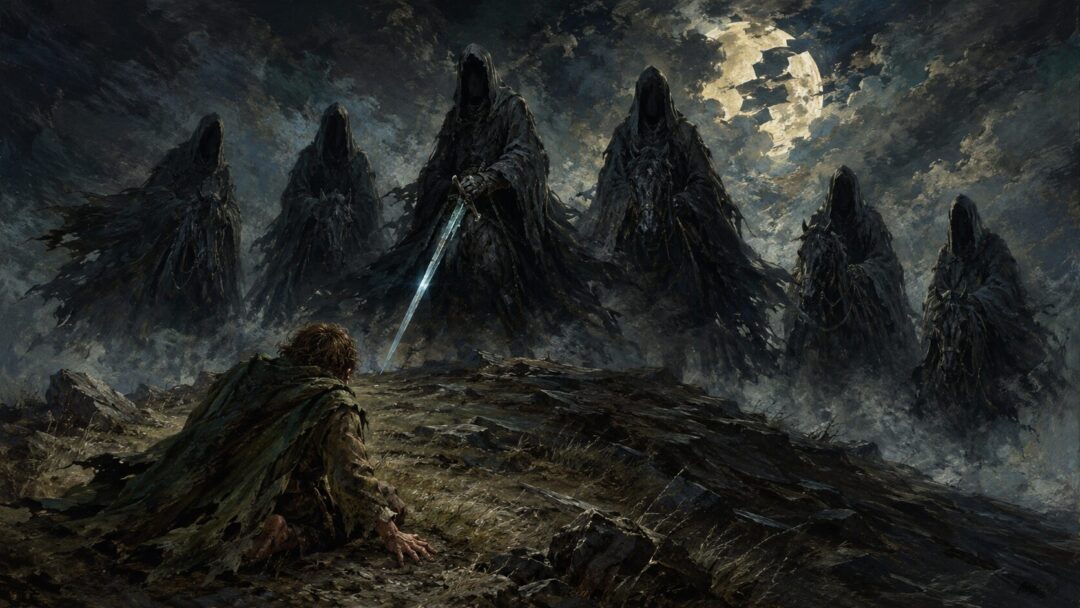
The Terror Was Always There
The Nazgûl were never harmless in the Shire. They were limited, but every limitation carried dread. Their poor daylight sight made them more unnatural. Their questions made them more invasive. Their dependence on smell, fear, horses, and rumor made them feel like death learning how to enter a front door.
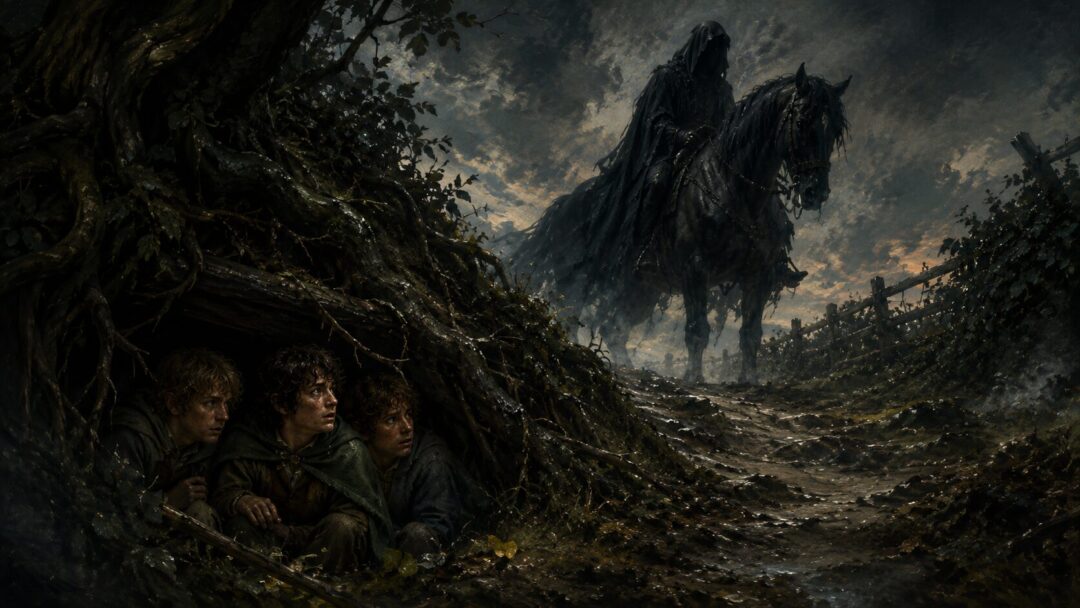
Before they were terrifying in the open, they were terrifying because they almost fit into the ordinary world and yet did not. A Rider on the road. A voice asking for Baggins. A shadow bending near the roots where frightened hobbits hide. The scene works because the Nazgûl are not all-powerful. They are close enough to miss.
And that narrow gap — between being found and being spared — is where the early story breathes. The Shire survives the first touch of Mordor not by strength of arms, but through delay, secrecy, ignorance, courage, and providence. The Ringwraiths are blind there only in the sense that matters most: they cannot yet see the full shape of the small resistance rising under their very noses.
Sources & Notes
- J.R.R. Tolkien, The Lord of the Rings, Book I, ch. 3 “Three Is Company”: the first Black Rider scenes in the Shire, including the Rider asking after Baggins and sniffing near the hidden hobbits.
- J.R.R. Tolkien, The Lord of the Rings, Book I, ch. 4 “A Short Cut to Mushrooms” and ch. 5 “A Conspiracy Unmasked”: the Shire pursuit remains tense but imperfect, with roads, local knowledge, the ferry, and chance delays frustrating the Riders.
- J.R.R. Tolkien, The Lord of the Rings, Book I, ch. 11 “A Knife in the Dark”: Strider explains that the Ringwraiths do not see the world of light as living people do, perceive living forms as shadows, and are stronger in darkness.
- J.R.R. Tolkien, The Lord of the Rings, Book I, ch. 11 “A Knife in the Dark” and ch. 12 “Flight to the Ford”: Frodo’s use of the Ring and the Morgul-knife wound show how the Riders become most dangerous when he is drawn toward their unseen mode of being.
- J.R.R. Tolkien, Unfinished Tales, “The Hunt for the Ring”: Tolkien’s account of the Nazgûl’s search, Khamûl’s role near the Shire, his greater sensitivity to the Ring, and his reduced endurance in daylight.
- J.R.R. Tolkien, The Silmarillion, “Of the Rings of Power and the Third Age”: background on the Nine Rings, the Nazgûl’s enslavement to Sauron, and their existence as Ringwraiths under his will.