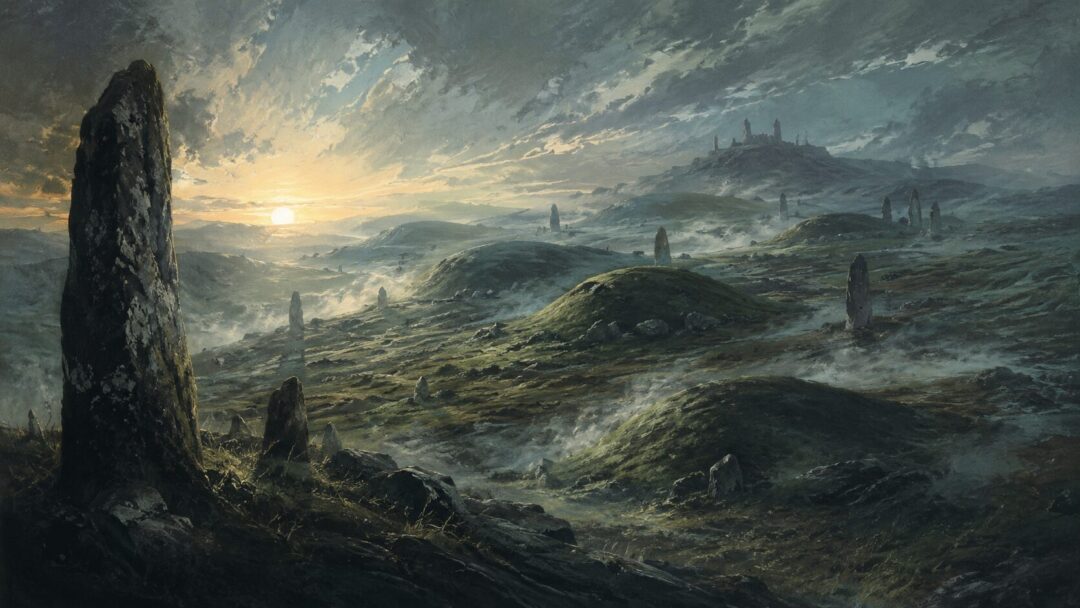
Before Frodo ever sees a Black Rider clearly, before Weathertop, before Rivendell, before the War of the Ring becomes a war at all, he wakes inside a tomb.
That is easy to forget. The Barrow-downs can feel like a strange early detour: fog, haunted hills, a pale sword, a cold hand, a rescue by Tom Bombadil. Yet beneath that eerie adventure lies one of the darkest pieces of northern history in The Lord of the Rings. The Barrow-downs are not merely spooky ruins near the Shire. They are the remains of a kingdom the Witch-king helped destroy, then continued to poison long after its people were gone.
What happens there reveals something essential about the Witch-king of Angmar. His power was not only terror on a battlefield. It was also memory turned into a weapon. He did not merely kill kings. He made their graves dangerous.
The Barrow-downs Were Old Before the Hobbits Arrived
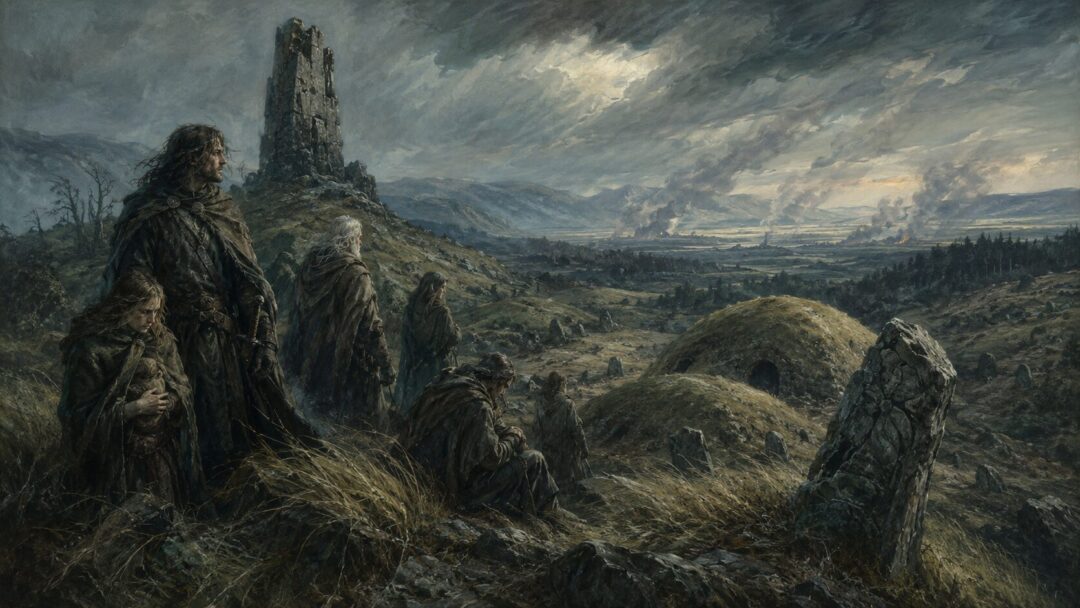
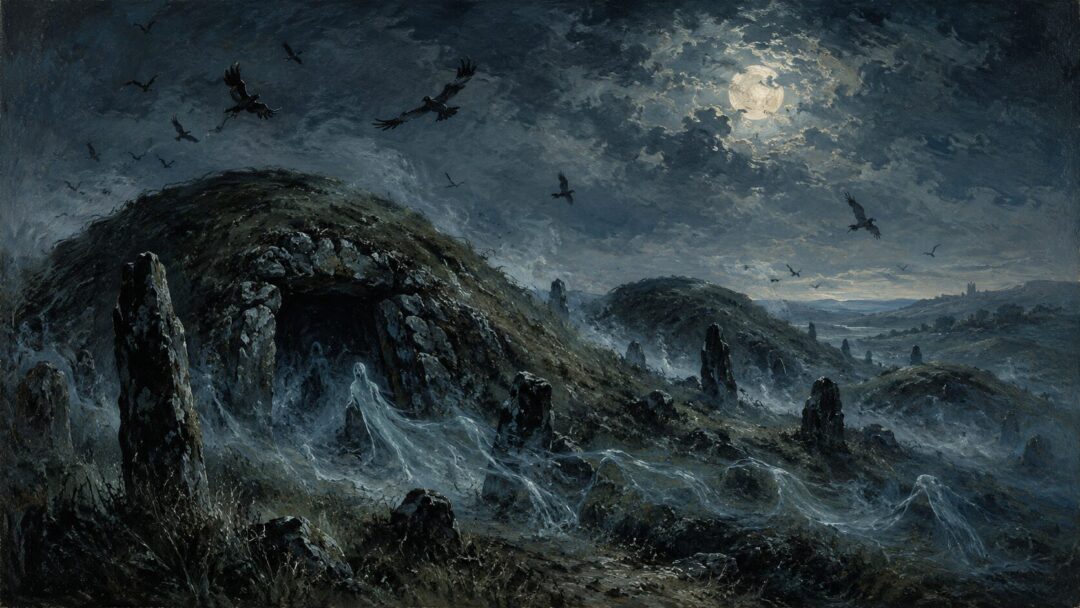
The Barrow-downs, called Tyrn Gorthad in Sindarin, lay east of the Old Forest and west of Bree. To the hobbits, they are an uncanny wilderness of green hills, standing stones, and ancient mounds. But the land’s history reaches far behind the small world of the Shire.
The mounds were burial places from very ancient days. Later, the Dúnedain of the North-kingdom revered and used them. In the world behind The Lord of the Rings, these hills are connected not with random horror, but with the long decline of Arnor, the northern realm founded by Elendil’s people after the fall of Númenor.
That matters because the Barrow-downs are not evil by origin. They begin as a place of memory, honor, and ancestry. Their horror comes later. The tragedy is not that the dead were buried there. The tragedy is that a holy or noble relationship with the dead was violated.
When Frodo and his companions enter the Downs, they are walking through the broken inheritance of the Dúnedain. The hills are beautiful, solemn, and old; then the fog turns them into a trap. That contrast is the key. The Witch-king’s shadow does not create the past. It corrupts it.
Cardolan Was the Kingdom That Would Not Quite Die
After the old North-kingdom of Arnor was divided, its lands became Arthedain, Cardolan, and Rhudaur. These successor realms were weaker apart than Arnor had been whole, and that weakness was exactly the kind of fracture Angmar could exploit.
Cardolan held lands including the Barrow-downs and the region toward the Old Forest. In the wars against Angmar, it suffered terribly. The Witch-king’s realm in the north did not simply attack a united enemy; it pressed upon divided Dúnedain realms already weakened by rivalry, disputed claims, and long decline.
A major blow came when Angmar’s forces devastated Cardolan and the last prince of its royal line was slain. Yet even after Cardolan ceased to function as a true kingdom, remnants of its people endured. The texts indicate that Dúnedain survivors remained in places such as the Barrow-downs and the Old Forest for generations.
That survival is important. Cardolan was not merely defeated and erased in one stroke. It lingered. Its people held on amid ruins, graves, and old loyalties. In that sense, the Barrow-downs were not only a cemetery. They were a final refuge of a dying northern people.
The Witch-king’s long shadow falls hardest here: not at the moment of conquest, but in what follows. He is associated with a war that leaves Cardolan broken, and later the land itself becomes haunted, preventing any easy return.
The Plague Made the Graves Empty Enough for Evil
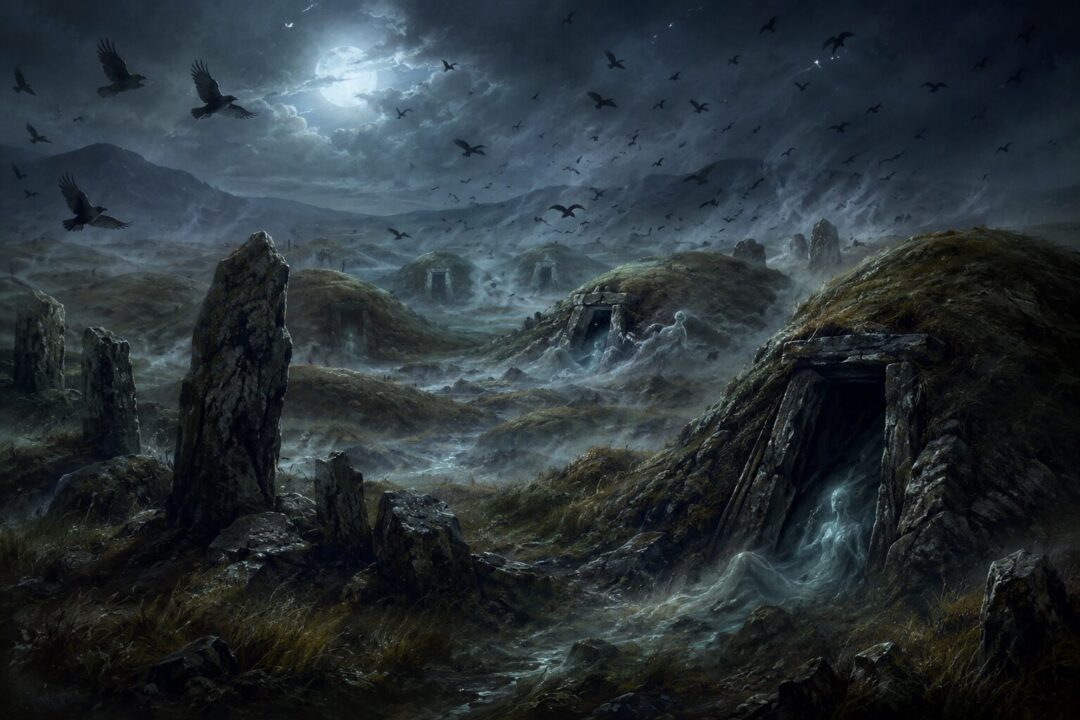
The Great Plague in the Third Age struck Eriador as well as Gondor and other regions. In Cardolan, it was catastrophic. The surviving Dúnedain of that land perished or were effectively brought to an end. After that disaster, evil spirits from Angmar and Rhudaur entered the deserted mounds.
This is one of the most chilling details in the northern history. The Witch-king’s earlier war had broken Cardolan’s body; plague finished what war had left. Then the Barrow-downs became something worse than abandoned.
The texts do not require us to imagine the Witch-king personally standing at every mound or performing a visible ritual in the form later fantasy might expect. What matters is the result: the evil associated with Angmar and Rhudaur enters a place that once held the honored dead of the North. The dead are not left in peace. The graves become occupied by Barrow-wights.
That is why the Barrow-downs reveal the Witch-king’s long shadow so powerfully. His work outlasts armies. Angmar itself is eventually overthrown, yet its evil continues to inhabit the landscape. The mounds remain dangerous long after the political kingdom of Angmar has fallen.
This is a different kind of victory. The Witch-king does not need to hold the land in order to ruin it.
The Barrow-wights Are a War After the War
The Barrow-wights are terrifying because they turn rest into imprisonment. They are not simply ghosts in a haunted place. They are hostile spirits dwelling in tombs, associated with the evil that came out of Angmar and Rhudaur. Their presence makes the Barrow-downs a lingering battlefield.
This is what the Witch-king’s shadow does to history. It keeps old wars from ending.
A battlefield can be abandoned. A ruined tower can collapse. But a haunted burial ground means the defeat continues psychologically and spiritually. The living avoid the place. Resettlement becomes dangerous. Memory itself becomes infected with fear.
There is a historical note that an attempt was made by Arthedain to reoccupy Cardolan, but it failed because of the terror of the wights. That detail shows how strategically effective this haunting was. The Barrow-downs did not merely frighten travelers. They helped keep Cardolan from being restored.
This is not conquest in the ordinary sense. It is denial. The Witch-king’s legacy makes a broken kingdom harder to heal. The land remains under a kind of posthumous occupation.
Frodo’s Tomb Scene Is Not Random Horror
When Frodo awakens in the barrow, the scene is intimate and dreadful. His friends lie beside him, pale and adorned as if for sacrifice or burial. A sword lies across their necks. A cold voice chants in the darkness. Frodo is tempted by panic and escape, but instead he cuts the hand that is creeping toward the sword and calls for help.
The horror works even for a first-time reader who knows nothing of Cardolan. But with the history behind it, the scene becomes much deeper.
The hobbits have been dressed into the memory of a dead war. They are small people from the Shire, yet they are almost absorbed into the old defeat of the North. The barrow is not just trying to kill them. It is trying to make them part of the same pattern: trapped, buried, silenced, and forgotten.
This is why the episode belongs in the story, even though it can seem separate from the main road to Mordor. The Ring-bearer’s journey begins by passing through a corrupted inheritance of the West. Before Frodo faces Sauron’s great designs, he encounters one of the old wounds those designs left behind.
The Barrow-downs teach the reader that evil in Middle-earth is not only ahead, in Mordor. It is behind, beneath the grass, inside history.
The Witch-king’s Shadow Reaches Toward the Ring-bearer
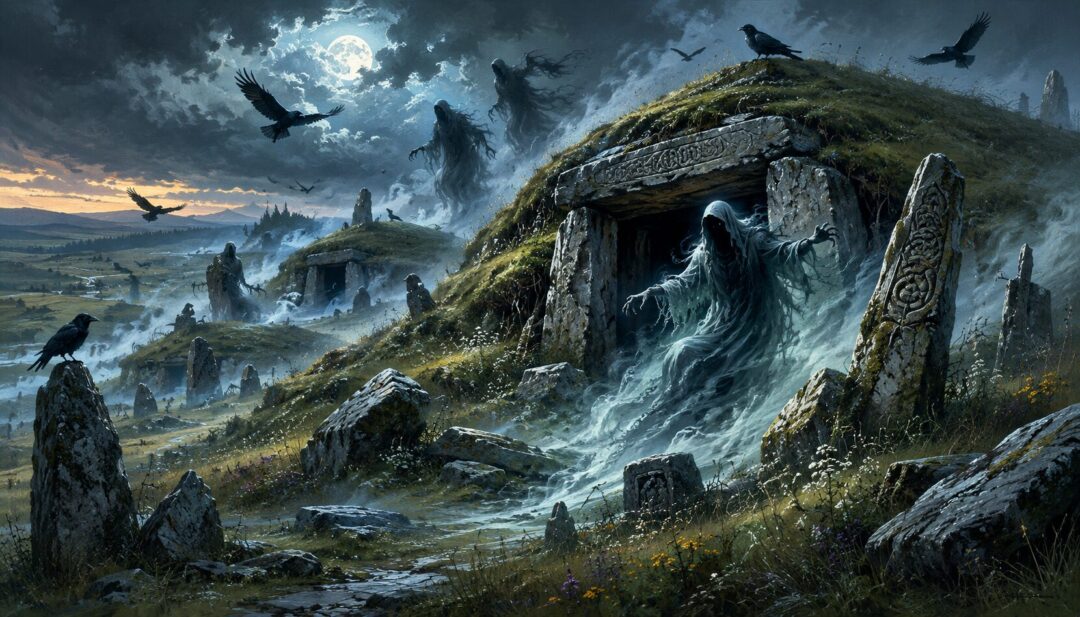
There is also a more direct connection between the Witch-king and the hobbits’ danger. In material concerning the movements of the Black Riders, the Witch-king is associated with entering Cardolan and stirring up the Barrow-wights during the hunt for the Ring. This belongs to a more detailed account outside the main narrative, so it should be handled carefully; but it fits the larger pattern. The old evil of Angmar is not sleeping harmlessly. It can be roused again.
That makes the Barrow-downs more than an accidental peril. They become part of the same net closing around Frodo: Black Riders on the roads, corrupted lands off the roads, fear in the open country, and ancient malice waiting in the tombs.
The Witch-king’s power is therefore not limited to his physical presence. His past actions have prepared places where the vulnerable can be trapped. His shadow makes geography itself hostile.
The Shire seems safe because it is small, green, and unnoticed. But just beyond its borders lie the Old Forest, the Barrow-downs, and the road to Bree. The borders of safety are thinner than the hobbits know.
The Blade in the Barrow Carries the Answer Back
The most remarkable irony of the Barrow-downs is that the hobbits do not leave only with trauma. They leave with weapons.
Tom Bombadil gives them blades taken from the barrow, blades made long ago by Men of Westernesse. These are not ordinary knives. They belong to the world of the old wars against Angmar. The blade Merry receives will later matter enormously on the Pelennor Fields.
During the confrontation with the Lord of the Nazgûl, Merry strikes the Witch-king behind the knee. The narrative says that no other blade, not though wielded by mightier hands, would have dealt that foe a wound so bitter, cleaving the undead flesh and breaking the spell that knit his unseen sinews to his will. Éowyn then delivers the final blow.
This should be phrased carefully. The blade does not “kill the Witch-king by itself,” and it does not make Merry the sole cause of his fall. But the text gives the Barrow-blade a special role. It was made by enemies of Angmar, and in the end one of those old weapons returns to help undo Angmar’s king.
That is the great reversal. The Witch-king turned the graves of Cardolan into traps. Yet from one of those graves comes the weapon that helps bring him down.
He corrupted memory, but memory answered.
The Long Shadow Is Not the Same as Final Victory
The Barrow-downs reveal that the Witch-king was terrifying because his evil endured. His realm could fall, his armies could be defeated, and still the places he had touched remained dangerous. He left behind fear, desolation, and spiritual pollution.
But the episode also reveals a limit.
The Barrow-wight can trap the hobbits, but not beyond rescue. Tom Bombadil breaks its power within the barrow. The old blades can be recovered. The memory of the Dúnedain has not been wholly erased. The weapon made against Angmar still carries meaning into the War of the Ring.
This is one of the quiet moral patterns of Middle-earth: evil can corrupt old things, but it does not always understand them. The Witch-king can use a tomb as a snare. He can fill a burial-place with terror. But he cannot completely control what the past contains.
The Barrow-downs are frightening because they show how long a shadow can last. They are moving because they show that shadow is not all that lasts.
Under the haunted hill, beside the bones of a defeated people, the hobbits find blades of the old North. One of those blades will travel south in the hand of someone the Witch-king would never have considered a mighty warrior. And on the field before Minas Tirith, the buried war of Cardolan will touch the living war of Gondor.
The Witch-king’s shadow reached far beyond Angmar. But so did the resistance to him.
Sources & Notes
- Tolkien Gateway, “Barrow-downs” — outlines the haunted burial mounds and the later presence of the Barrow-wights. https://tolkiengateway.net/wiki/Barrow-downs
- Tolkien Gateway, “Witch-king of Angmar” — explains the Witch-king’s wars against Arnor and his long shadow over the North. https://tolkiengateway.net/wiki/Witch-king_of_Angmar
- Tolkien Gateway, “Merry Brandybuck” — provides context for the Barrow-blade’s later role in the Witch-king’s defeat. https://tolkiengateway.net/wiki/Merry_Brandybuck
Sources added for Barrow-downs, Angmar, and the Barrow-blade connection.